Research
As part of the research for the Hush app project, my initial focus was on understanding the competitive landscape, particularly in comparison to popular apps like Headspace and Calm, which offer similar anxiety-relief and wellness features. The research revealed that these leading apps provide a range of resources, including meditations, deep breathing exercises, journaling, guided visualizations, and soothing nature sounds.
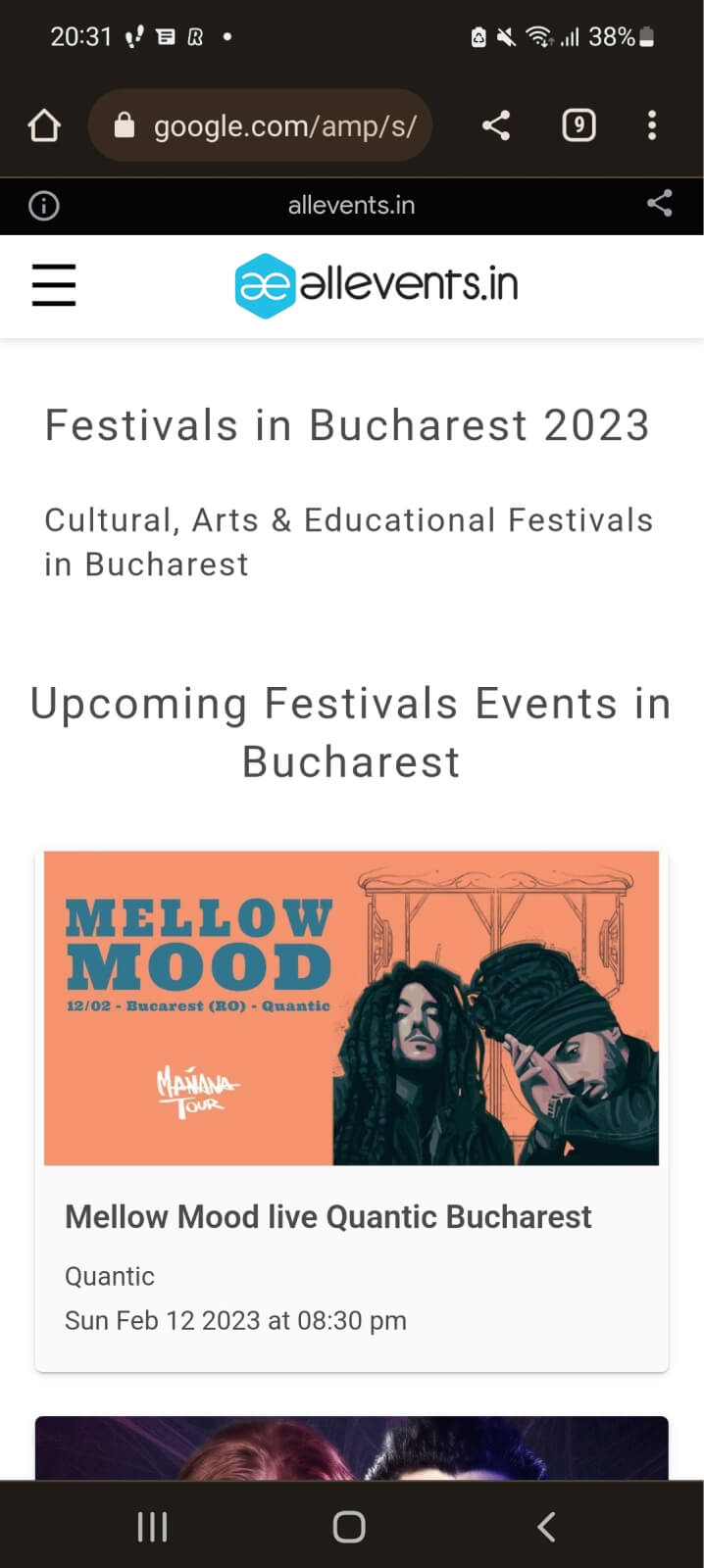
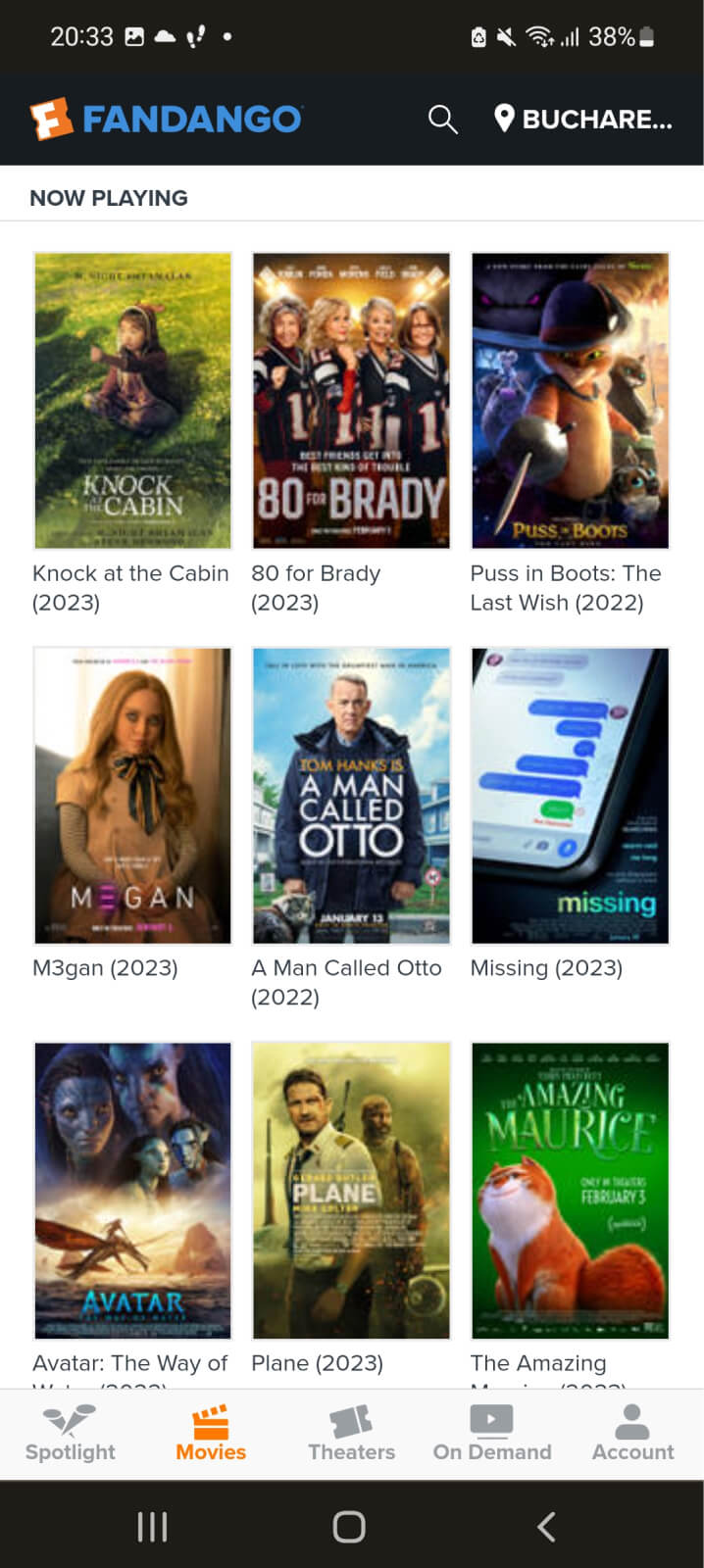
However, the research identified key areas where the Hush app can stand out, such as incorporating daily challenges aimed at pushing people to step out of their comfort zones, providing recommendations for social events, and providing a comprehensive free trial experience.
The research served as a valuable foundation for the development of the Hush app, with the goal of offering a unique and compelling solution in the mental health and wellness space.
Additionally, in the initial phase of the research for the Hush app, I gathered valuable insights by exploring a wide range of online blogs and forums where people shared their personal experiences and perspectives on managing anxiety. These authentic and diverse narratives have provided me with a broader understanding of the challenges people face and the strategies they seek for anxiety relief.
While these insights are not based on formal interviews, they have been instrumental in shaping my approach and ensuring that the Hush app addresses real-world needs and concerns.
Framing the problem
The research findings have enhanced my understanding of the problem I aimed to solve.
General Problem: People with anxiety often struggle to engage in social interactions and form new connections, experiencing discomfort and fear.
Solution: Develop an app designed to offer a supportive environment, enabling users to progressively overcome social anxiety. This involves presenting structured daily challenges to encourage users to step out of their comfort zones and facilitating access to events like movies and concerts, thus promoting opportunities for social engagement.
Solving the problem offers benefits to both users and the business. Users of the app gain a comprehensive tool for managing social anxiety, allowing them to gradually improve their social confidence through daily challenges and event access.
The business can benefit from this by implementing effective monetization strategies, which may include freemium models, subscription plans, and in-app advertising.
Designs and prototypes
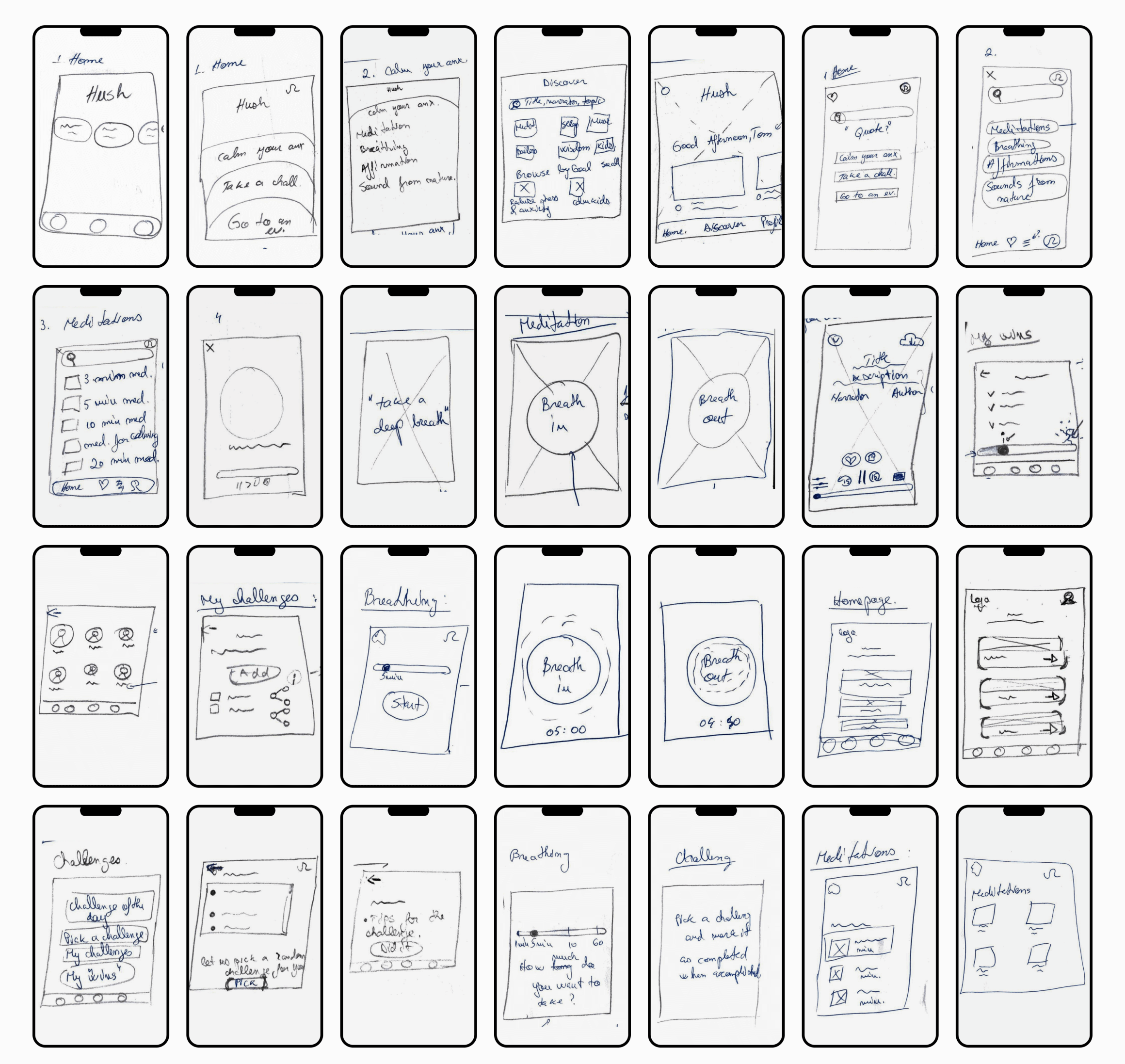
Sketches
As I progressed in the Hush app project, I translated my research and problem framing into visual design concepts by sketching. This step brought me closer to the goal of creating an app that empowers users to overcome social anxiety and confidently engage in social interactions.
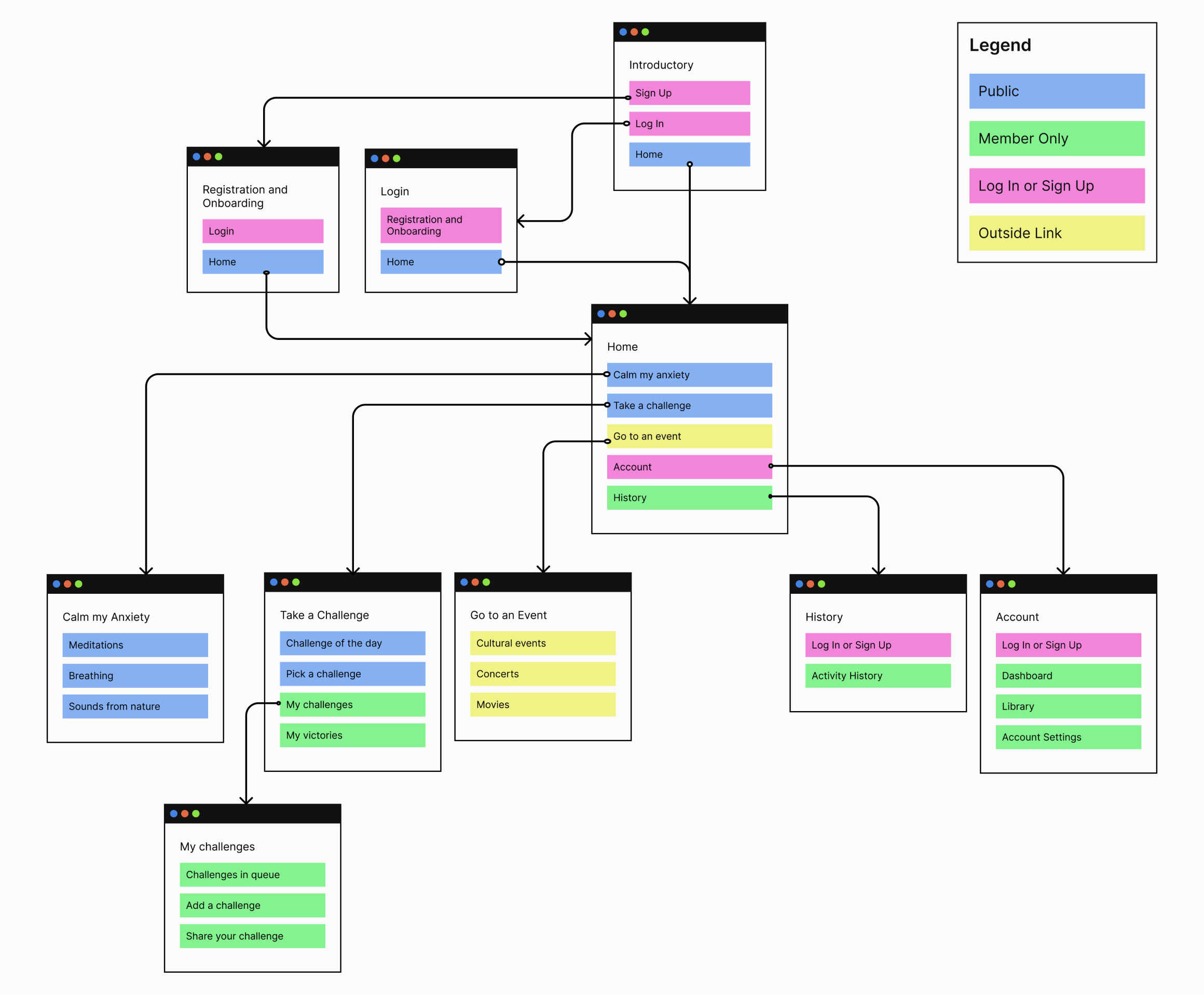
Sitemap
The sitemap helped me to organize the application's structure with the goal of creating a user-friendly experience.Thus, I focused on 3 key objectives:
Providing anxiety-calming support within the application.
Encouraging users to step out of their comfort zones and build self-confidence through daily challenges.
Offering the option to select and participate in various social events, including cultural events, concerts, and movies.
Wireframes
To offer a clear comparison of the design's evolution, I displayed the initial design versions alongside the final wireframes. This approach simplifies the demonstration of the UI's progression, highlighting the transformation from an initial simplistic appearance to a more aesthetically pleasing final design.
Main Screen
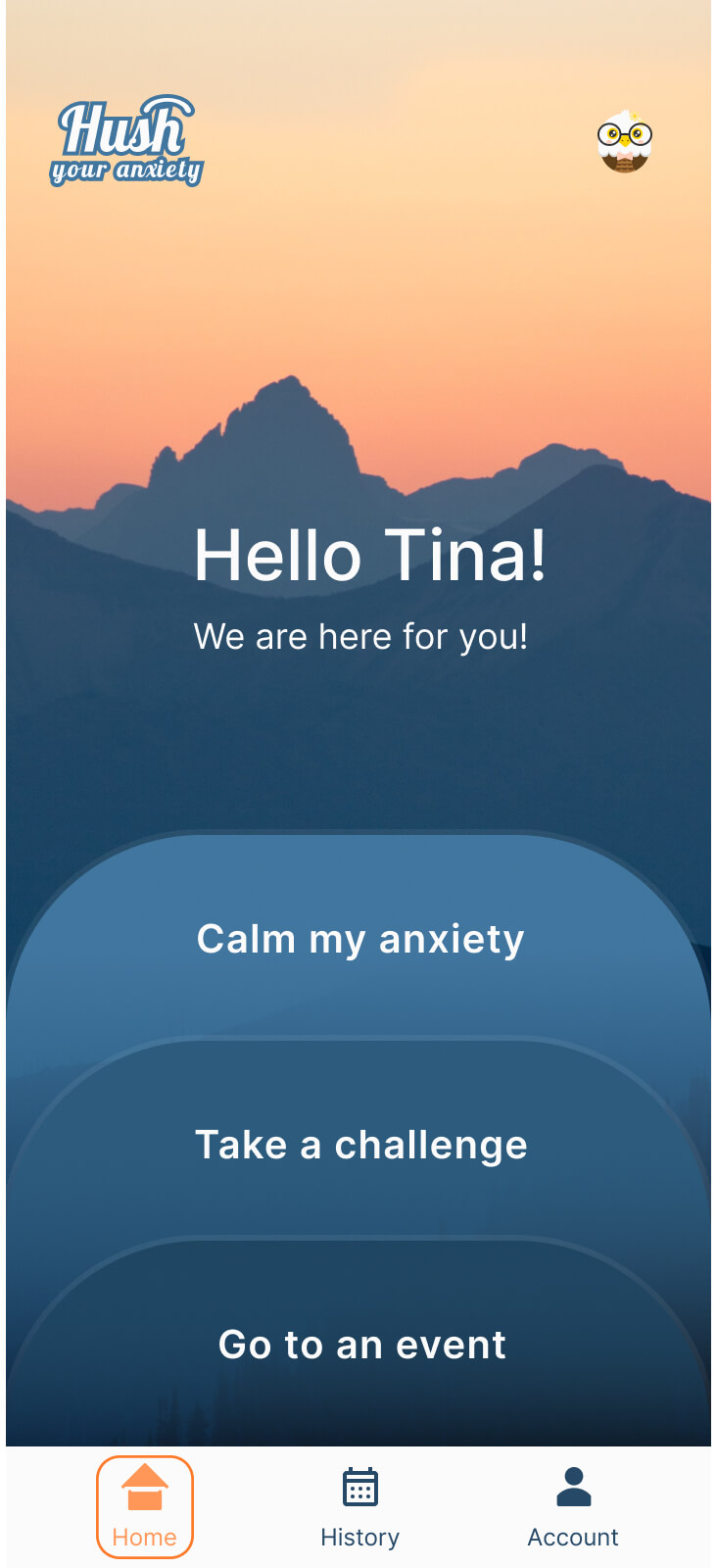
During the design process of the health app, my primary objective was to cultivate a sense of companionship rather than only creating an application. As such, I integrated a warm and reassuring welcome message, ensuring users that they are not alone in their journey.
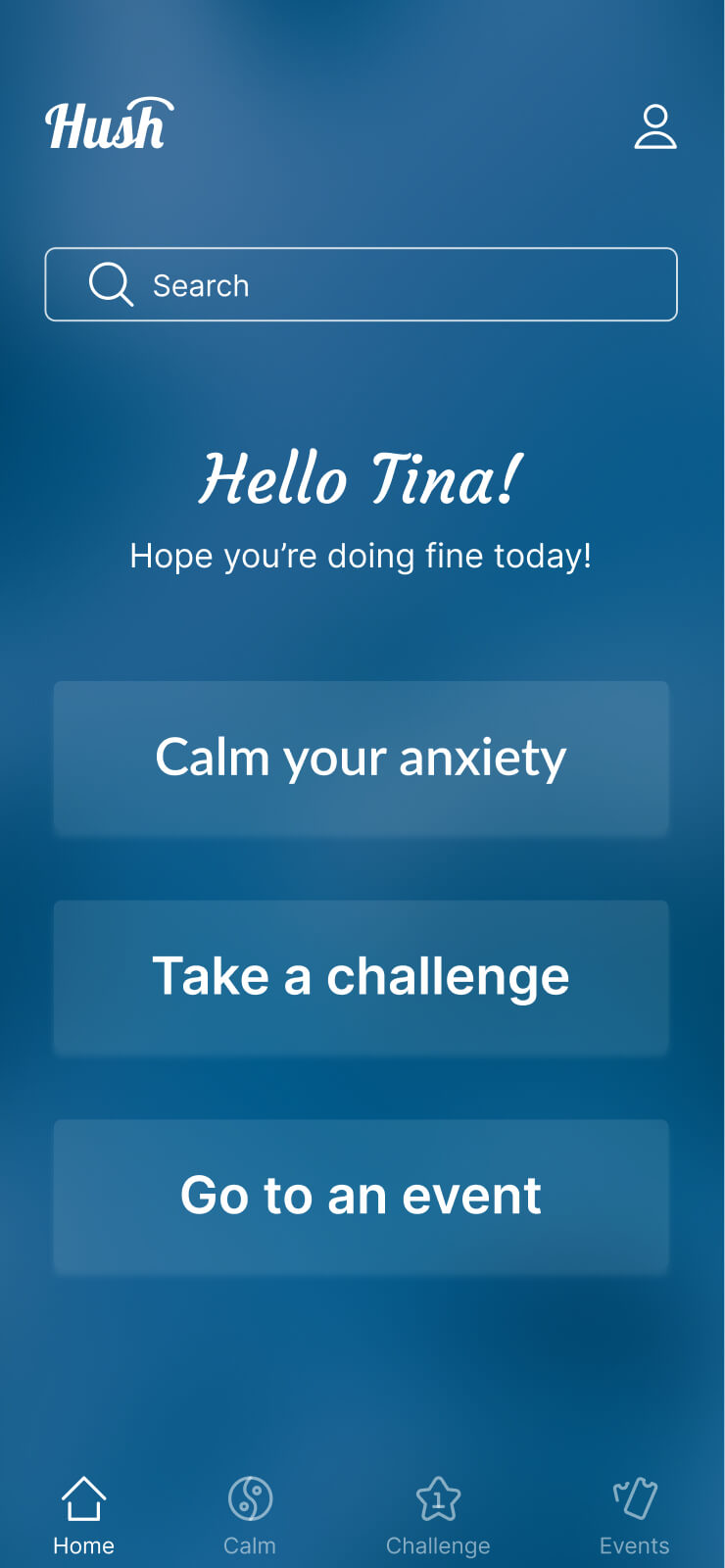
In contrast to the initial design, characterized by a plain blue background and sharp-edged buttons, the final design emits tranquility and delight. The peaceful mountainous wallpaper and the soft, rounded edges of each category button foster a calm and pleasing ambiance.
Initial Design
Final Design
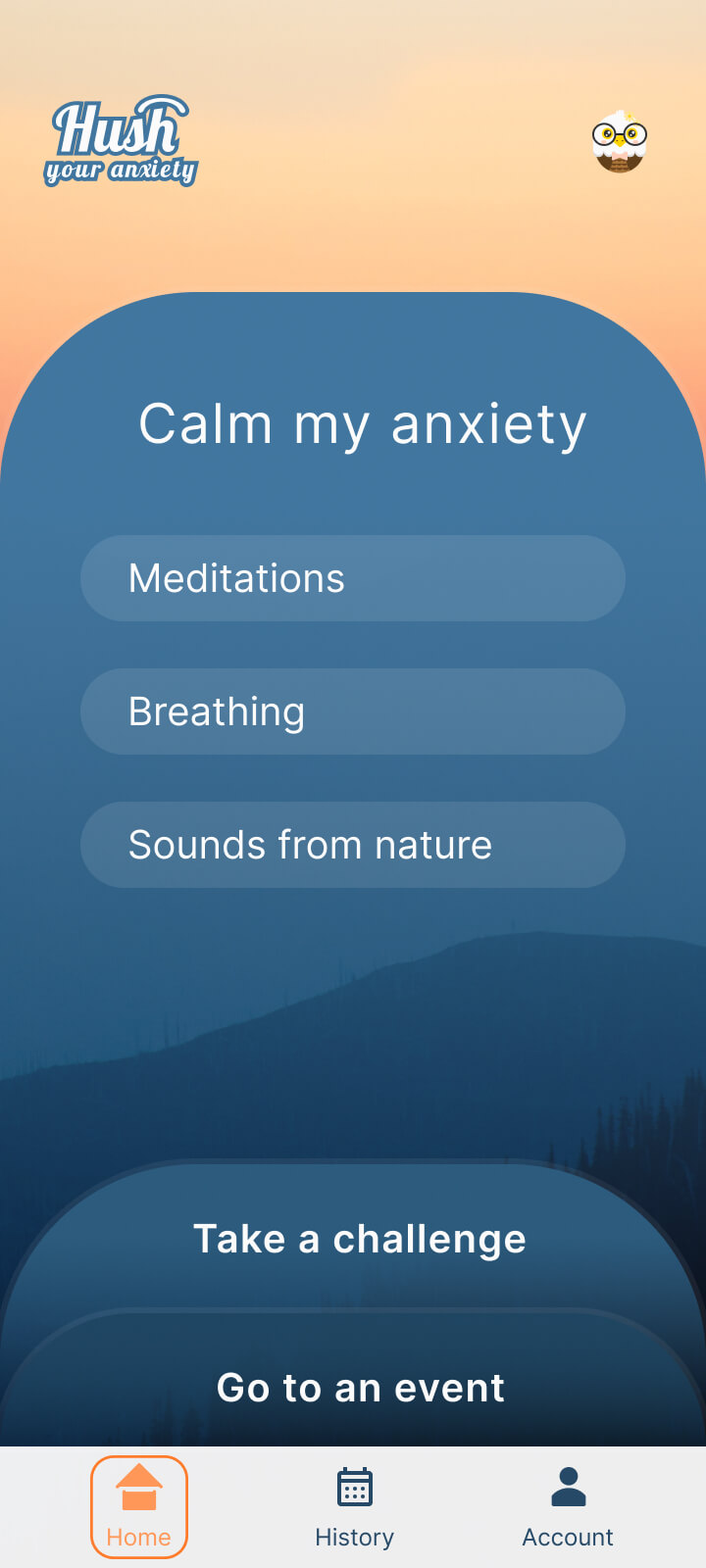
‘Calm my anxiety’ screen
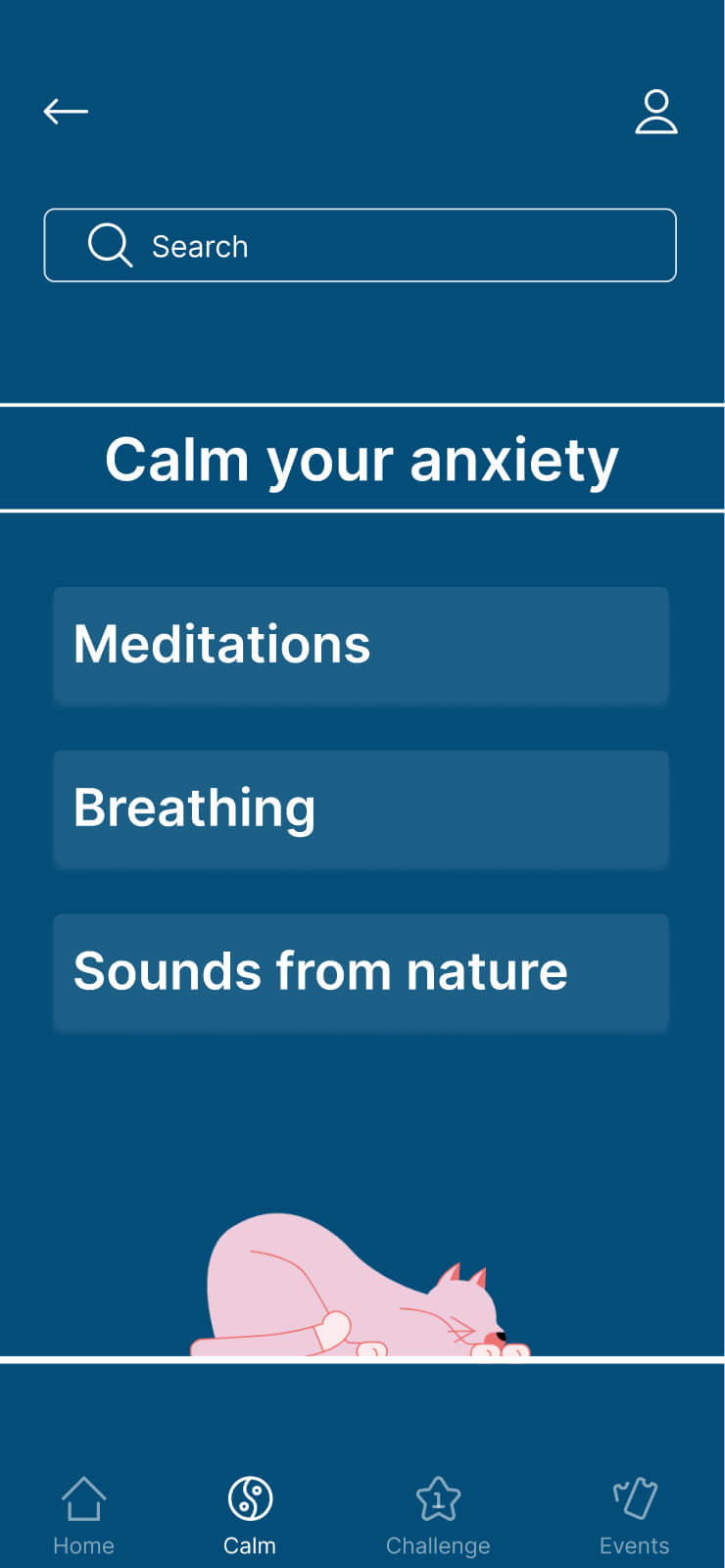
The 'Calm my anxiety' category is tailored to help users regain their calmness when faced with anxiety in social situations. It offers users the opportunity to benefit from meditations, breathing exercises, or soothing nature sounds to alleviate their anxiety.
Initial Design
Final Design
‘Take a challenge’ screen
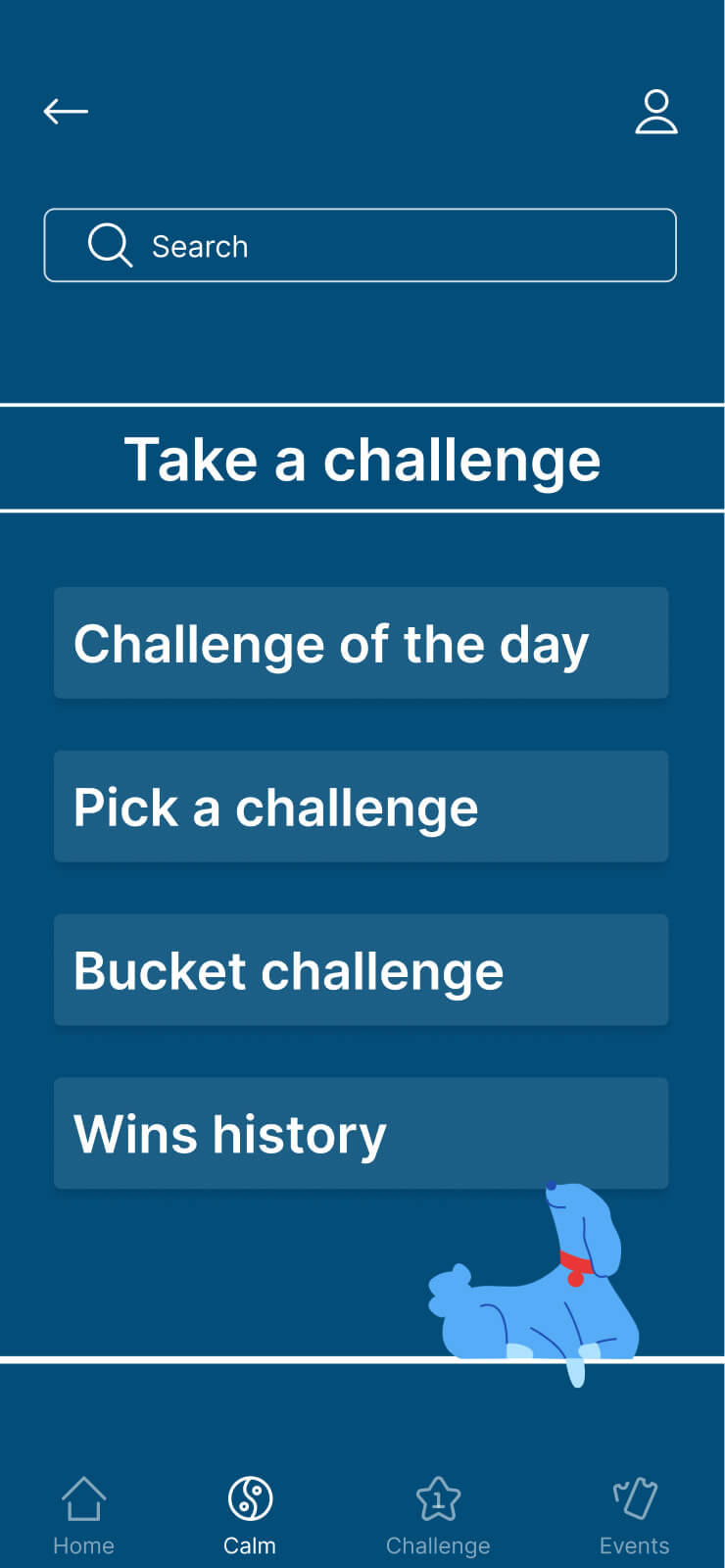
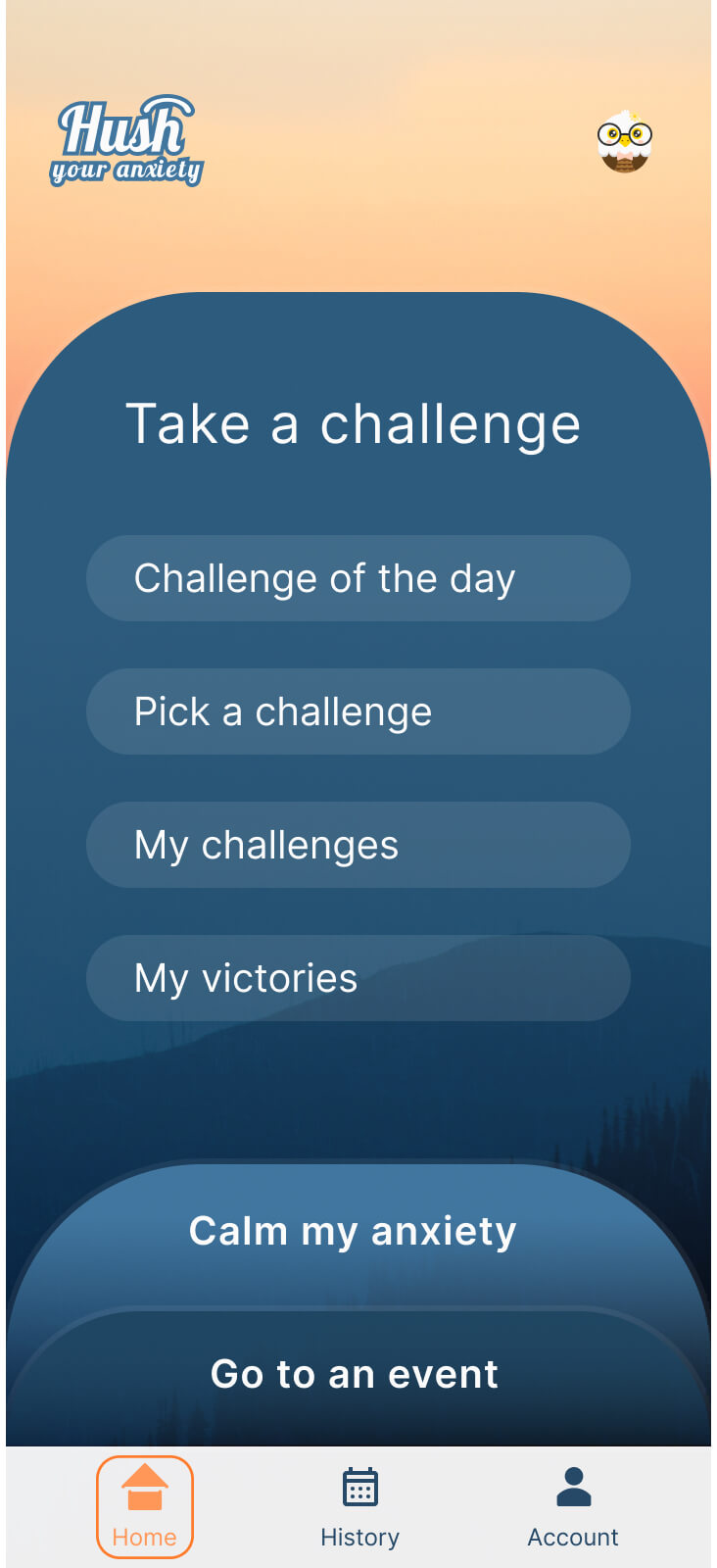
The 'Take a challenge' category is designed to motivate people to step out of their comfort zones and embrace various challenges to enhance their self-confidence.
The order of categories follows a logical sequence, starting with the 'Challenge of the Day' and concluding with a comprehensive list of all the challenges users have completed.
Initial Design
Final Design
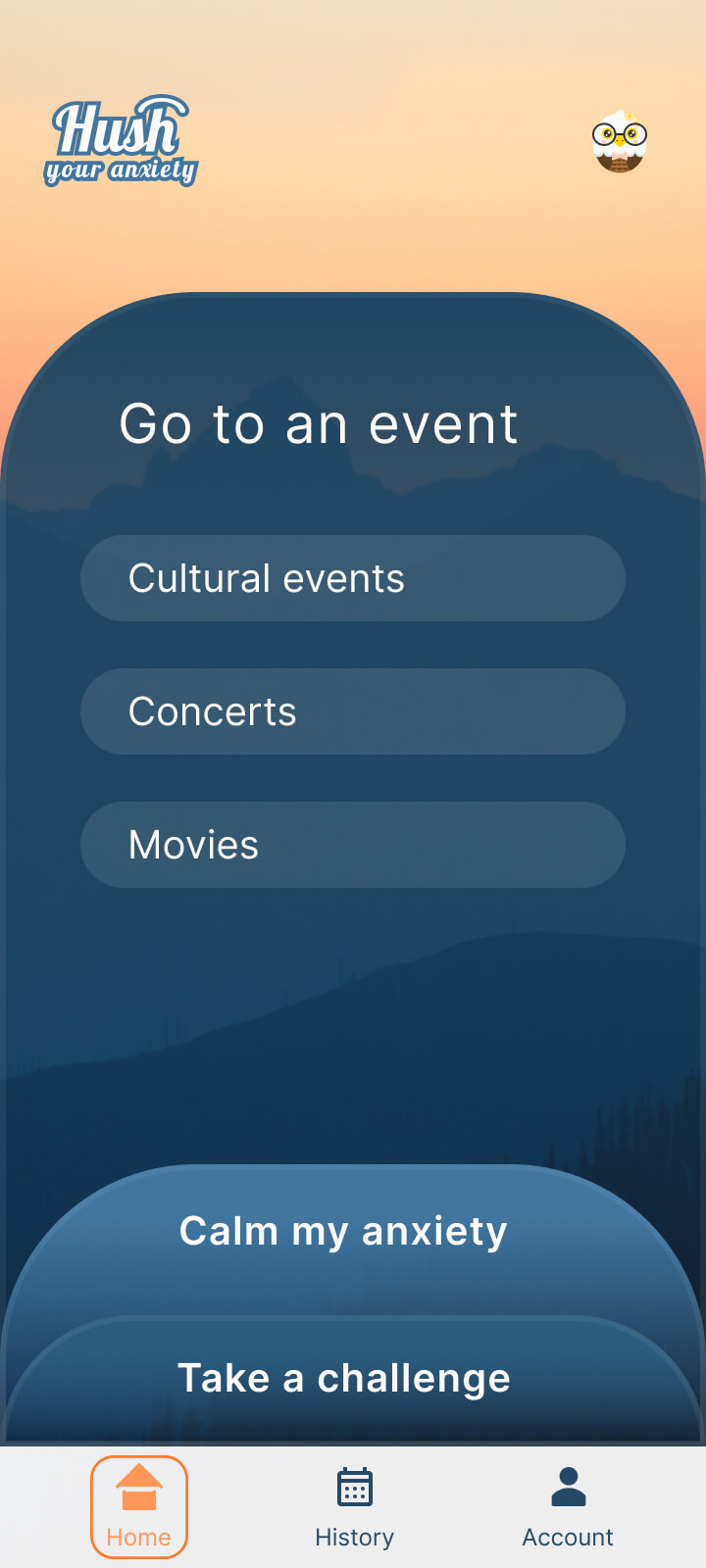
‘Go to an event’ screen
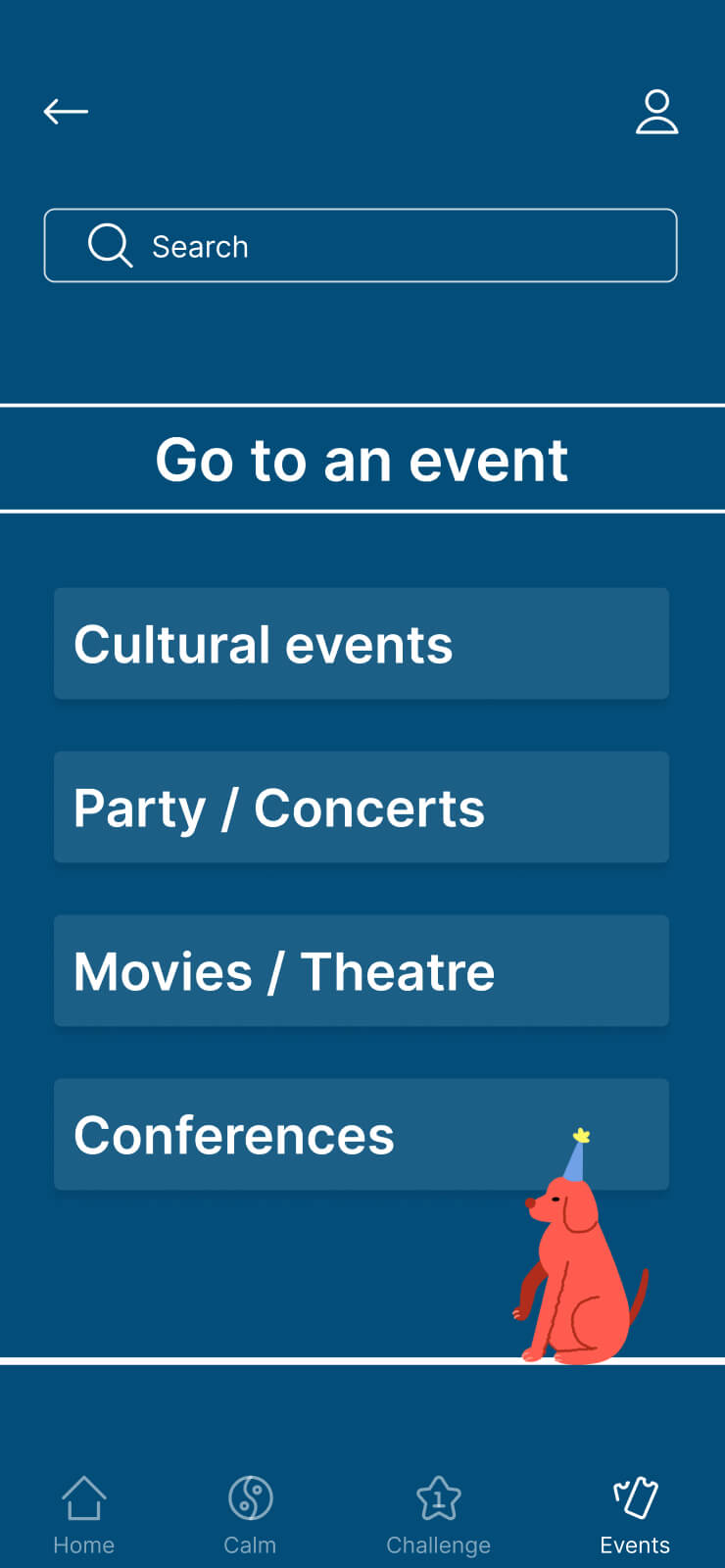
The 'Go to an event' category acts as an invitation for people to participate in social gatherings.
Within this category, users can explore a diverse range of social event ideas that encourage interactions with others, promoting meaningful social connections. The recommendations offered in the app, aim to inspire and guide users in their choices, ultimately creating opportunities for expanding their social network.
Initial Design
Final Designs
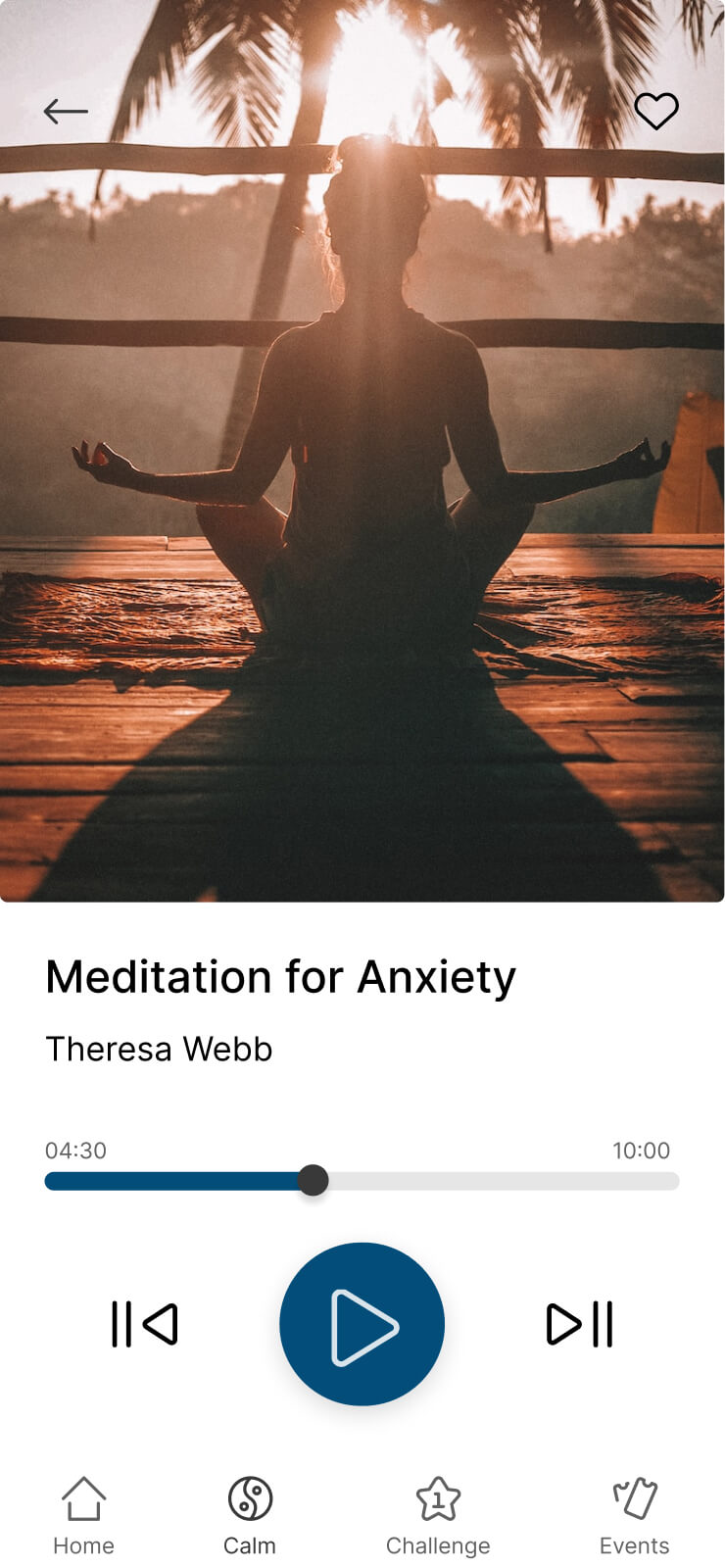
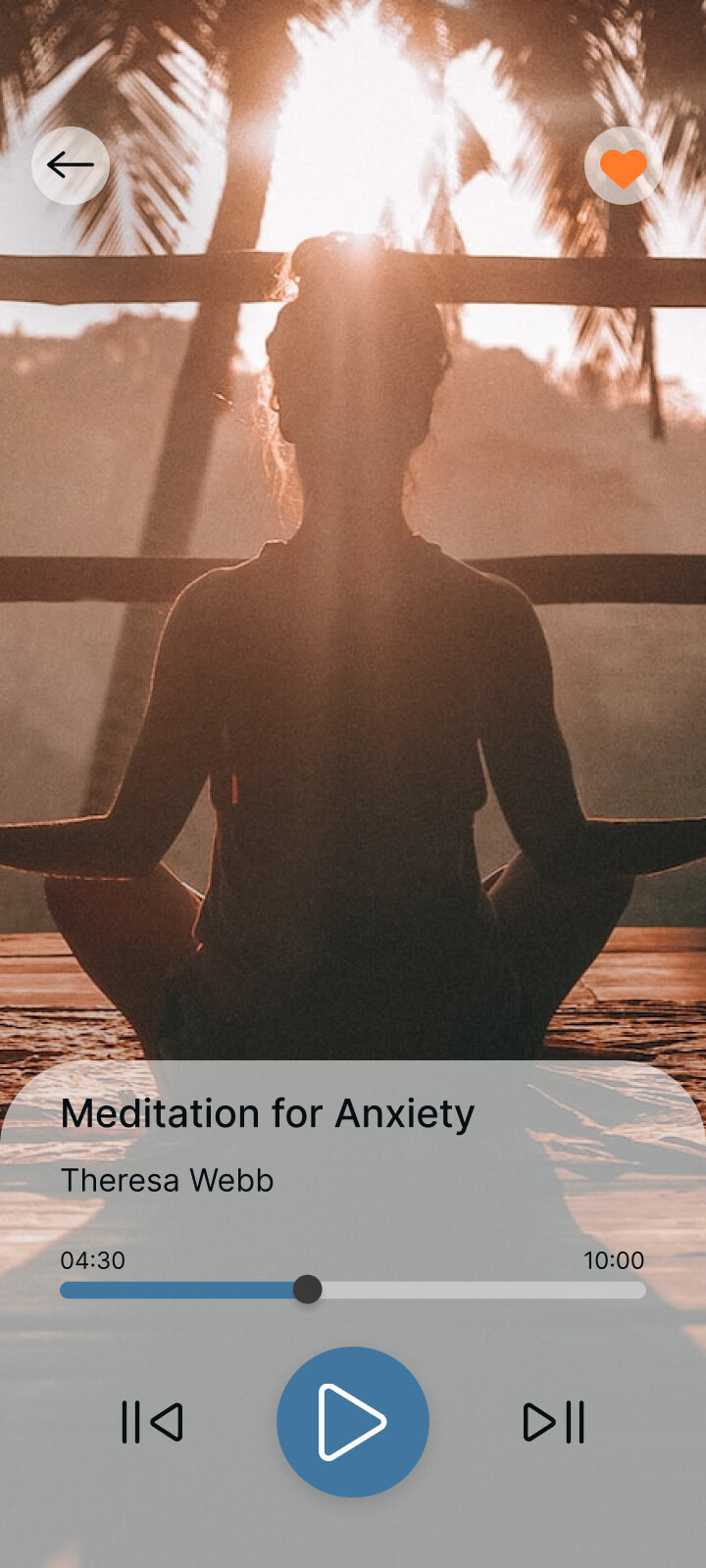
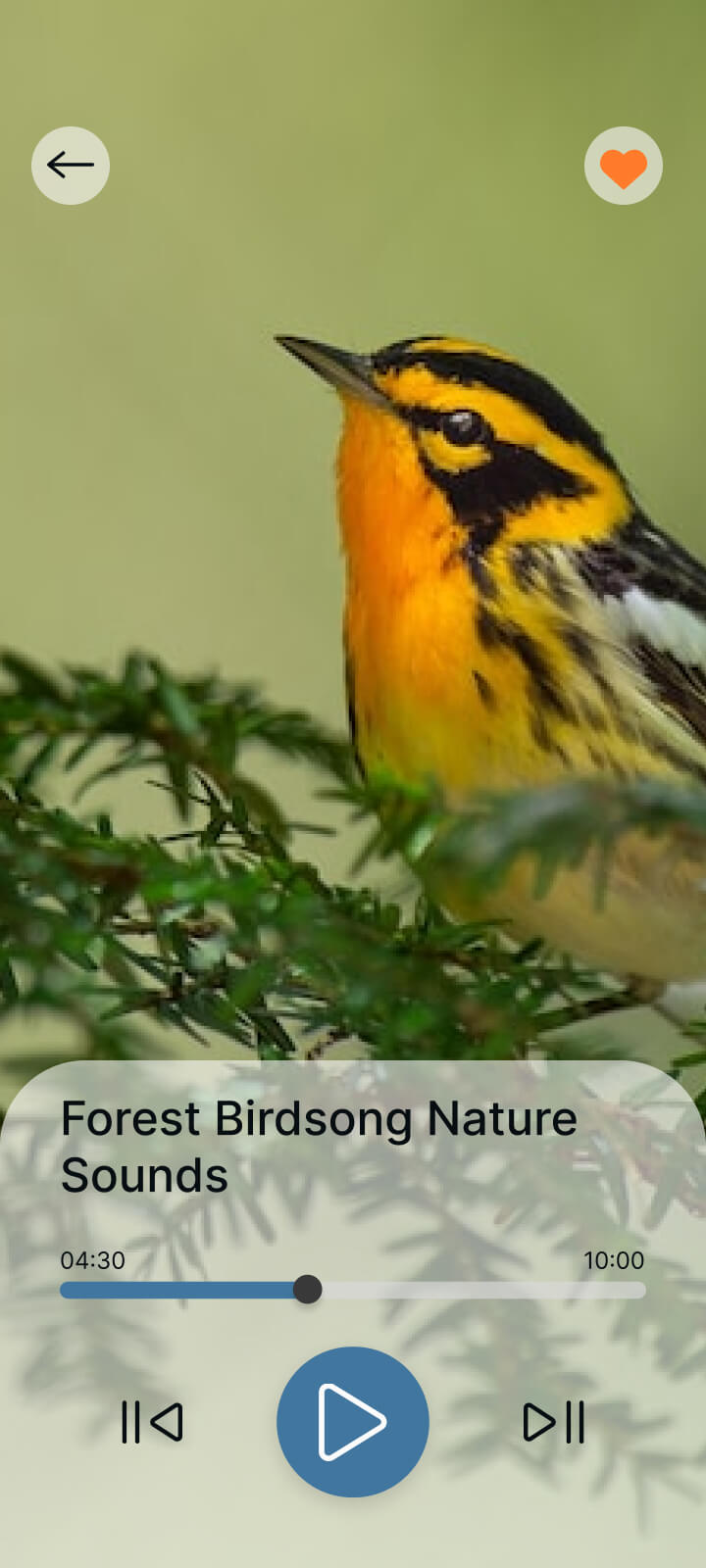
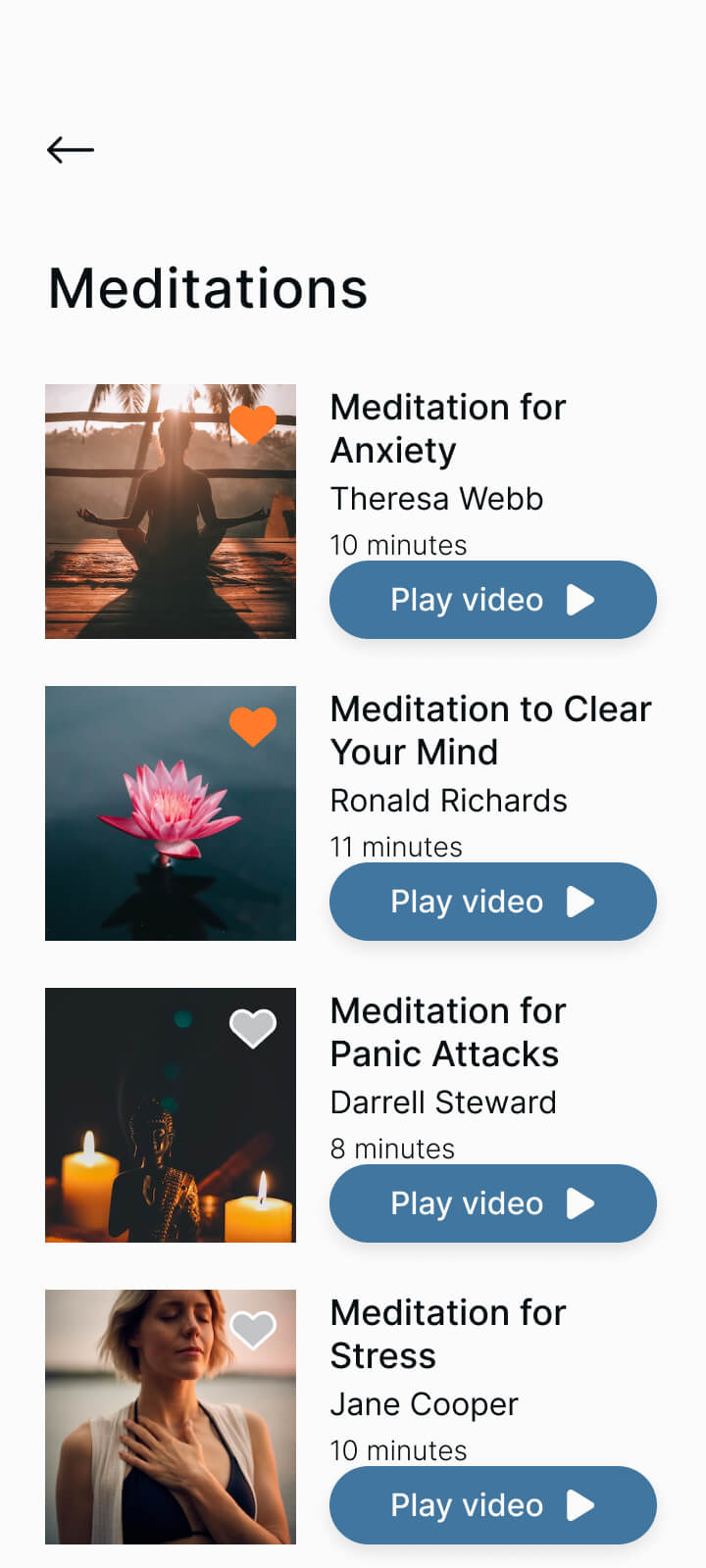
‘Meditations’ ,‘Sounds from nature’ and ‘Breathing’ sections
Meditations, nature sounds, and breathing sessions are proven techniques for reducing stress and anxiety. By providing multiple options such as meditations, nature sounds, and breathing exercises, users can choose the method that works best for them, allowing for a personalized experience.
Having these resources within a single category makes it convenient for users to access and use them when needed, promoting regular self-care practices.
Final Designs
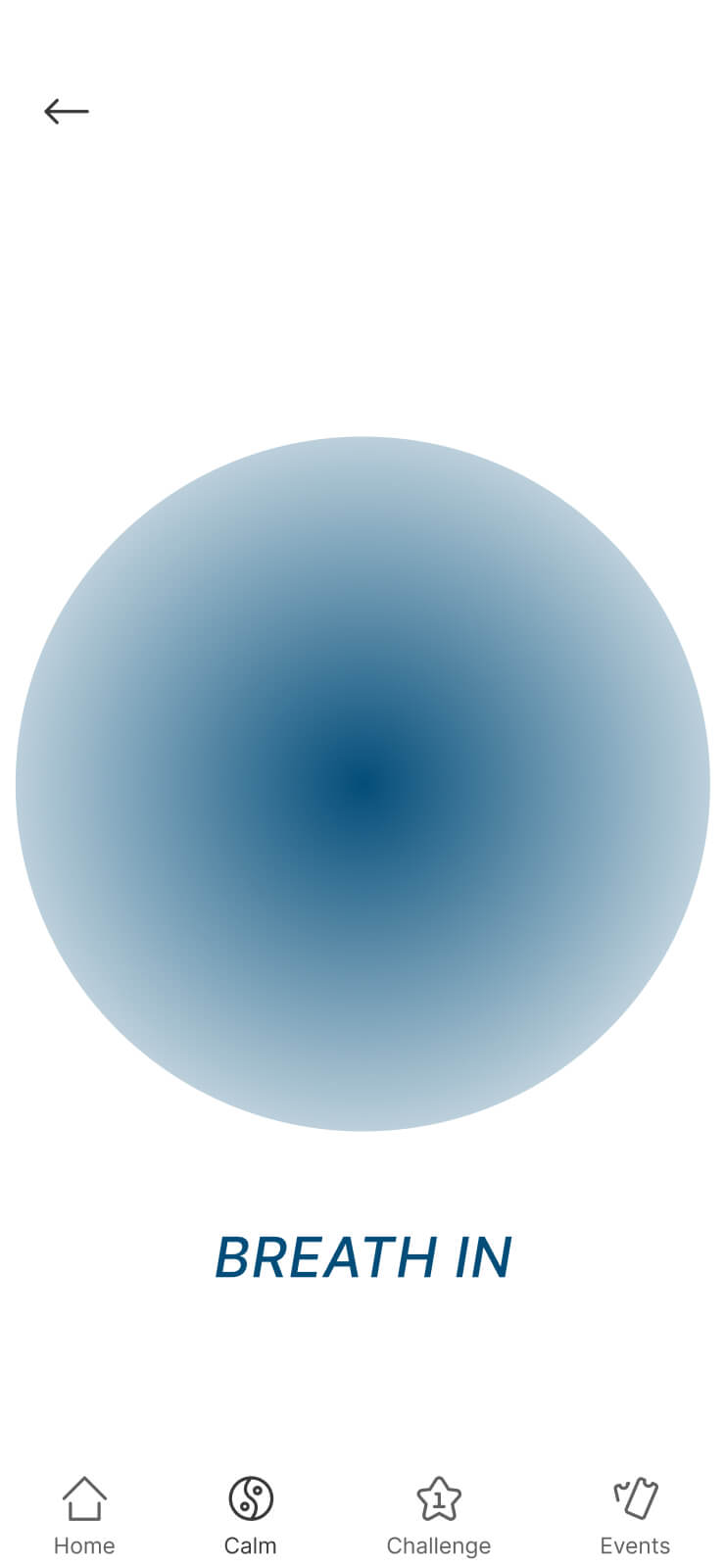
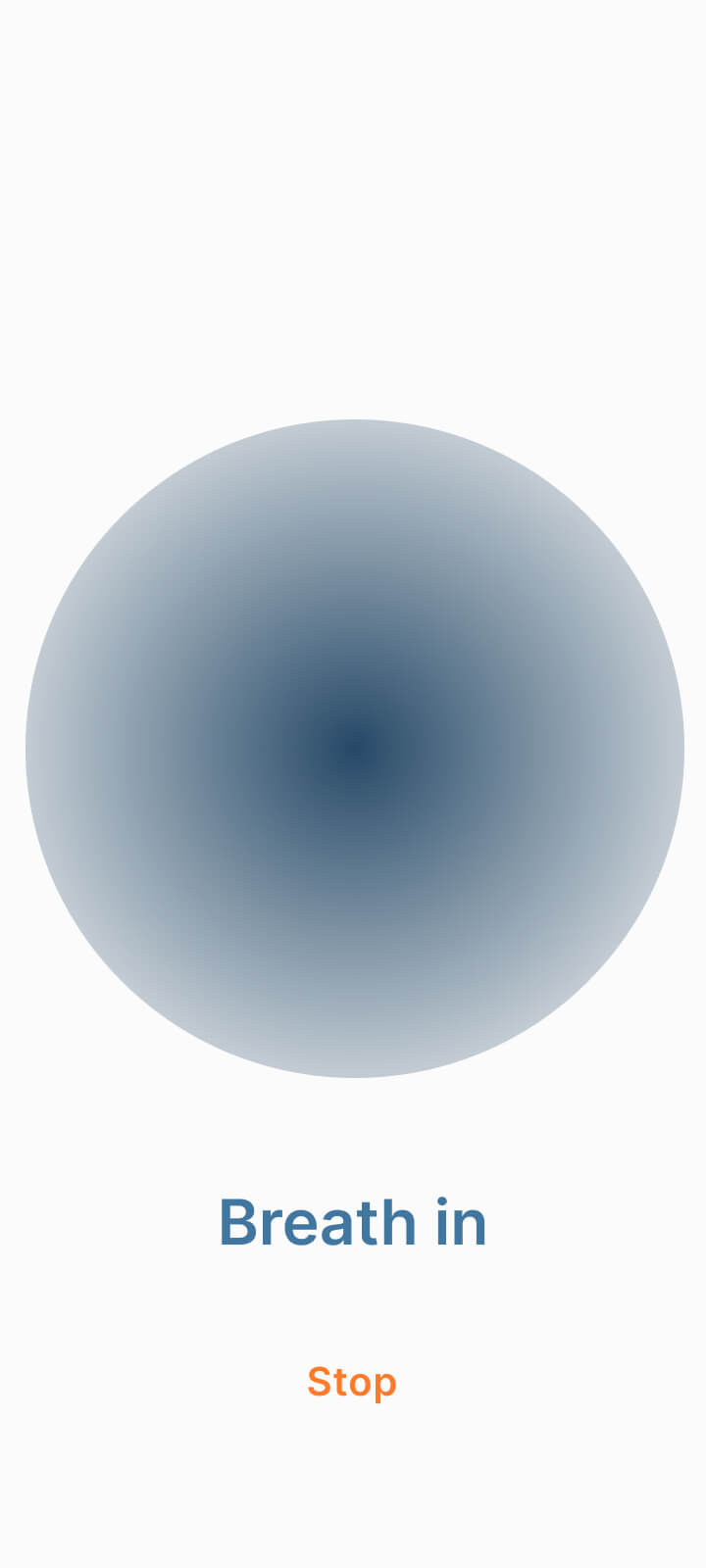
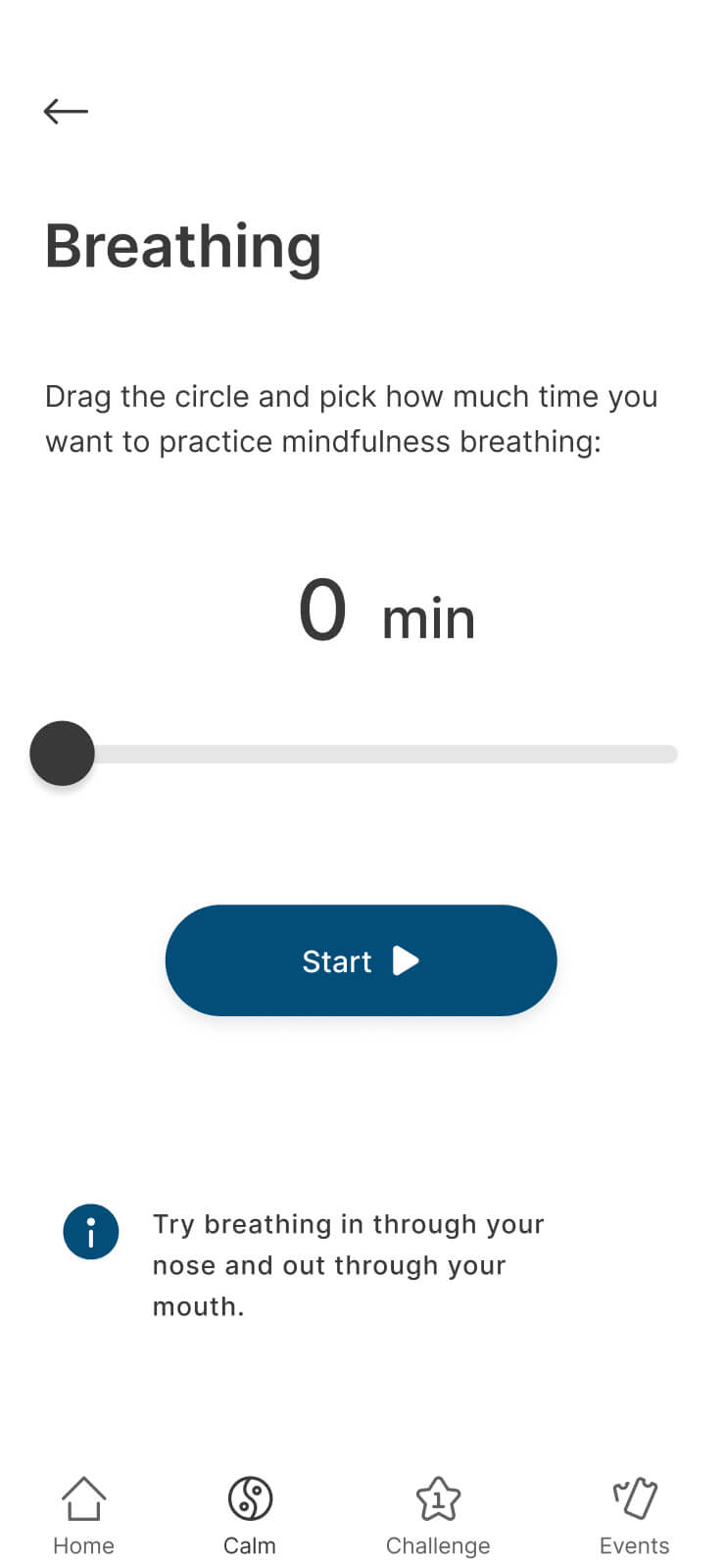
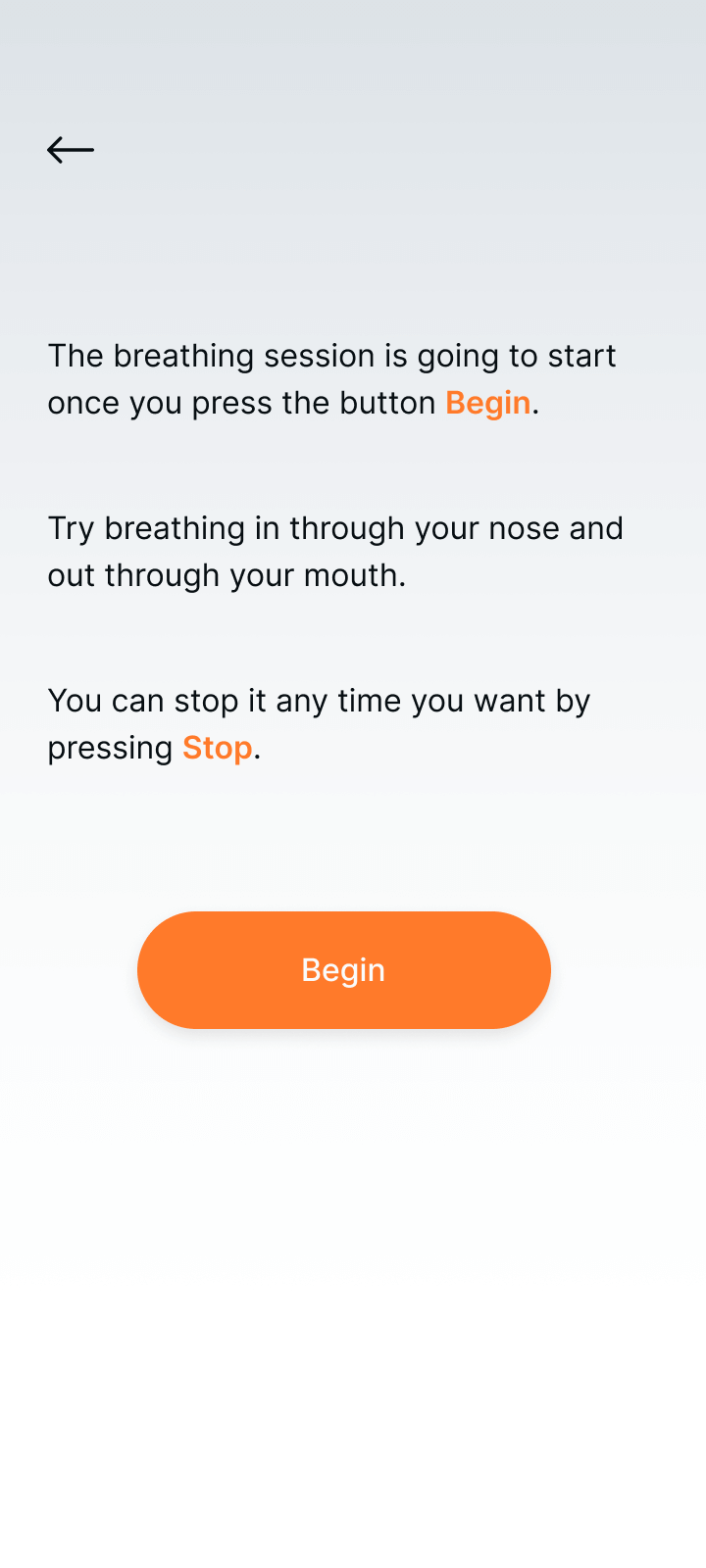
The Breathing section serves as a valuable tool in helping users reduce anxiety through mindful breathing practices.
Unlike the initial design, where people had to specify the duration for their mindful breathing, I made the decision to remove this setting. Instead, users are now introduced directly to the breathing exercise, allowing them the flexibility to finish the practice according to their own preference.
This modification empowers users by giving them greater control over how they utilize the app, enabling them to tailor its usage to their specific needs and preferences.
Initial Designs
Final Designs
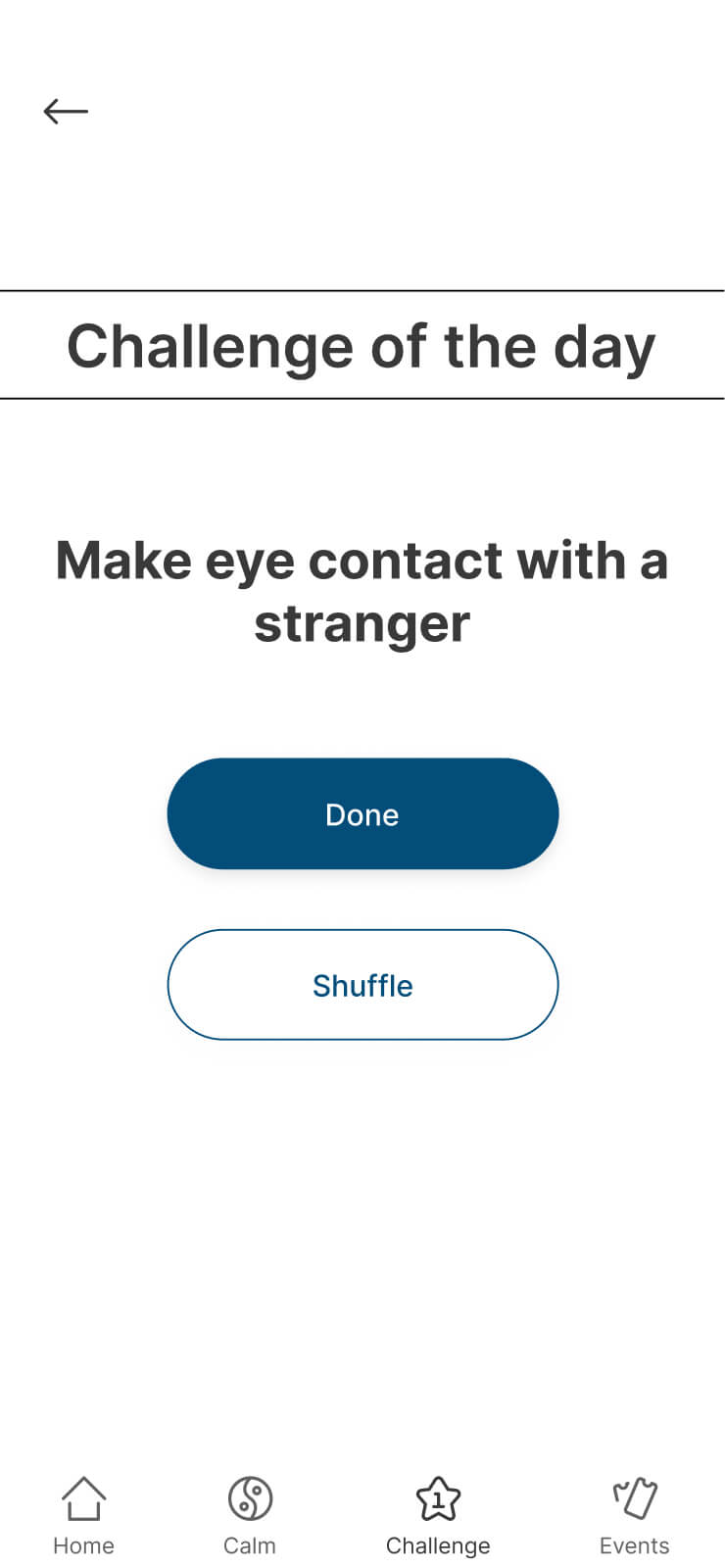
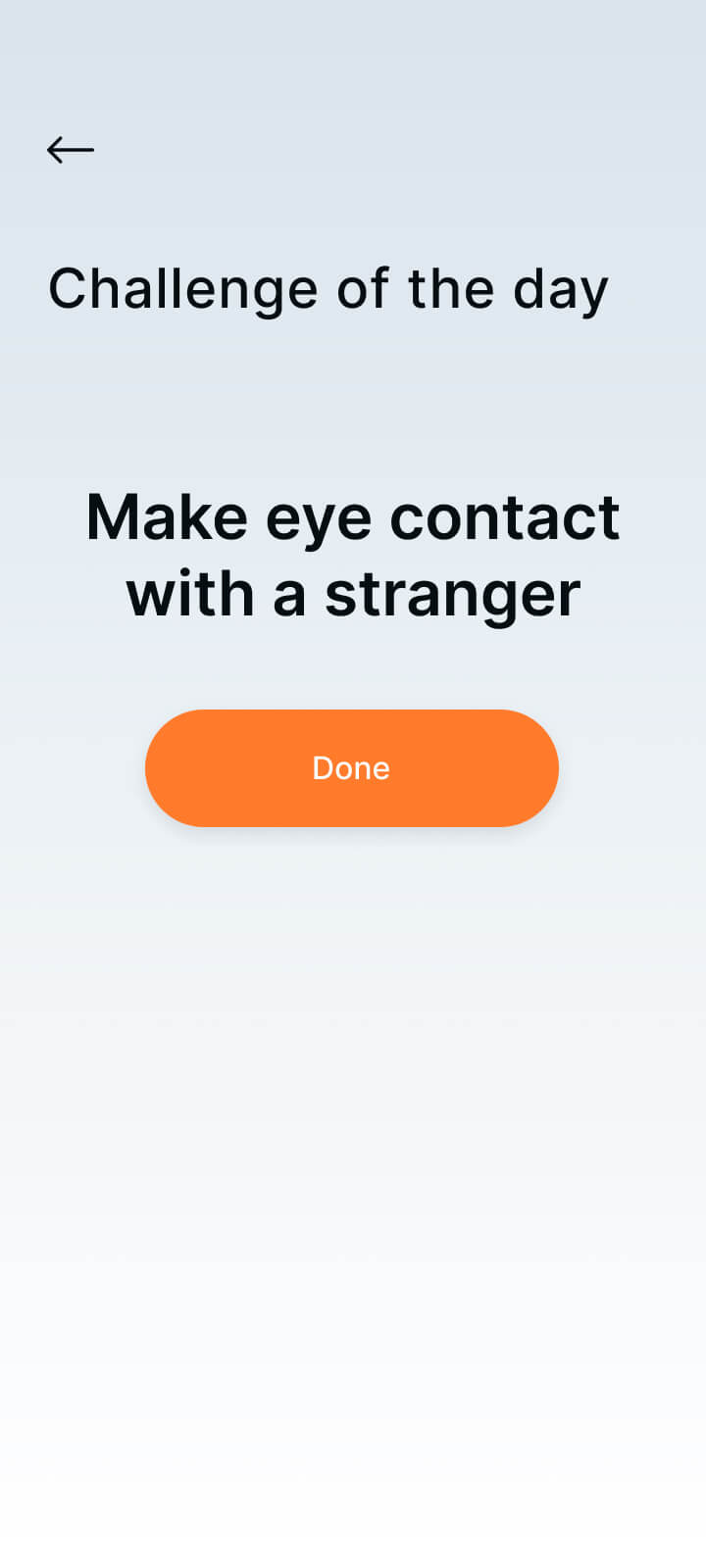
‘Challenge of the day’ category
The 'Challenge of the Day' category offers users a specific daily goal, promoting personal growth and self-improvement. Setting a daily challenge can encourage users to develop a consistent routine of trying new things and stepping out of their comfort zone.
Every day introduces a fresh challenge, maintaining a dynamic and engaging user experience.
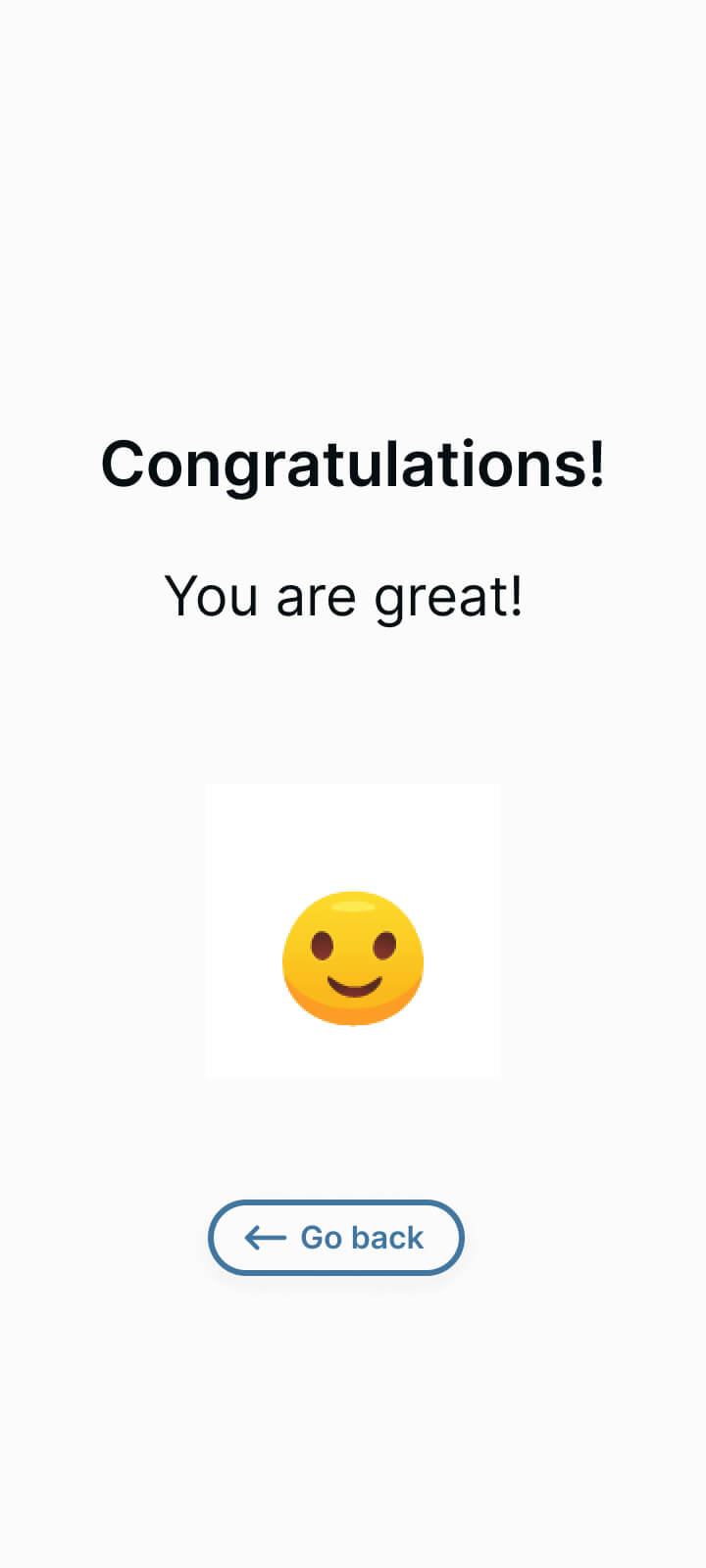
Completing each task, users receive a congratulatory message, providing support and acknowledging their efforts.
The 'Challenge of the Day' category offers users a specific daily goal, promoting personal growth and self-In the final design, I opted to remove the 'Shuffle' button to enhance the uniqueness and exclusivity of each daily challenge."improvement. Setting a daily challenge can encourage users to develop a consistent routine of trying new things and stepping out of their comfort zone.
Initial Design
Final Designs
‘Pick a challenge’ category
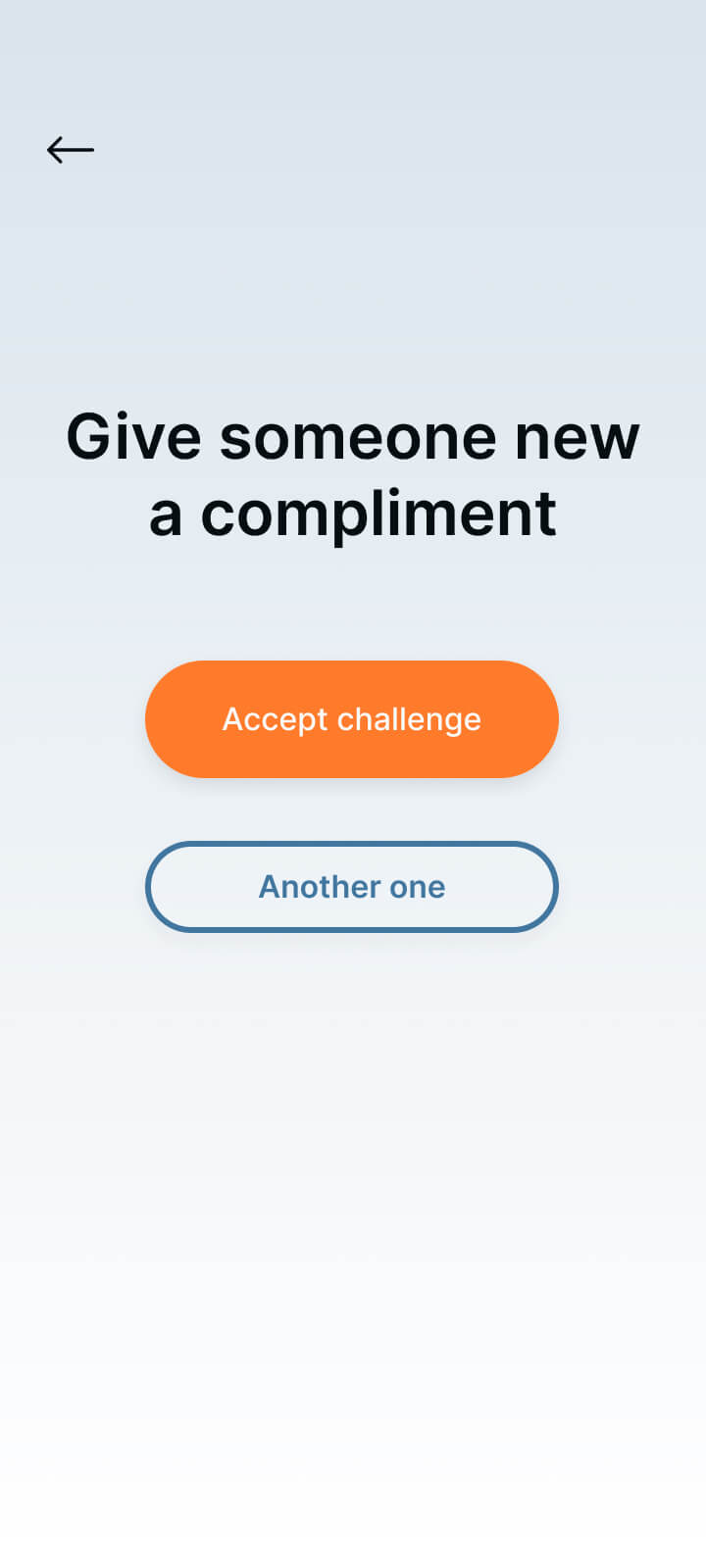
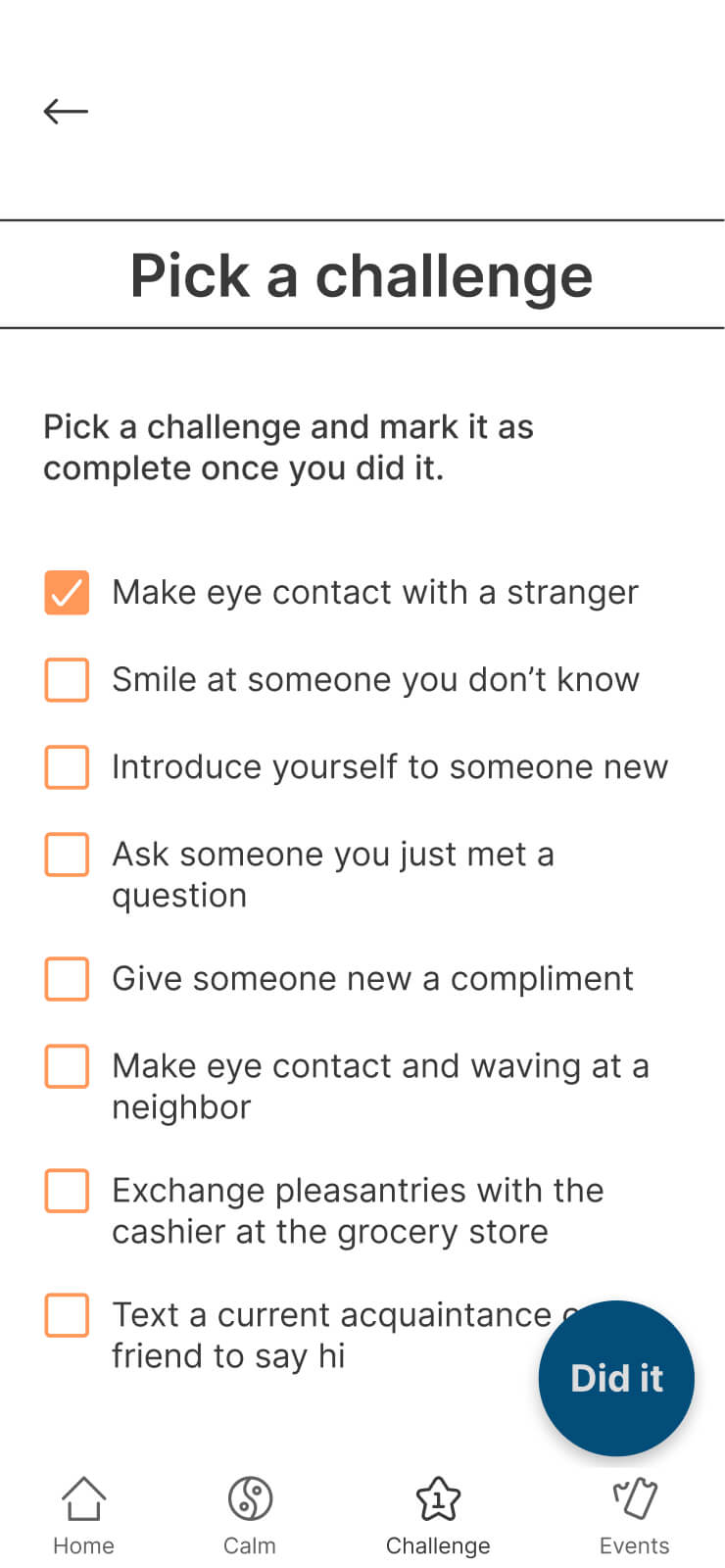
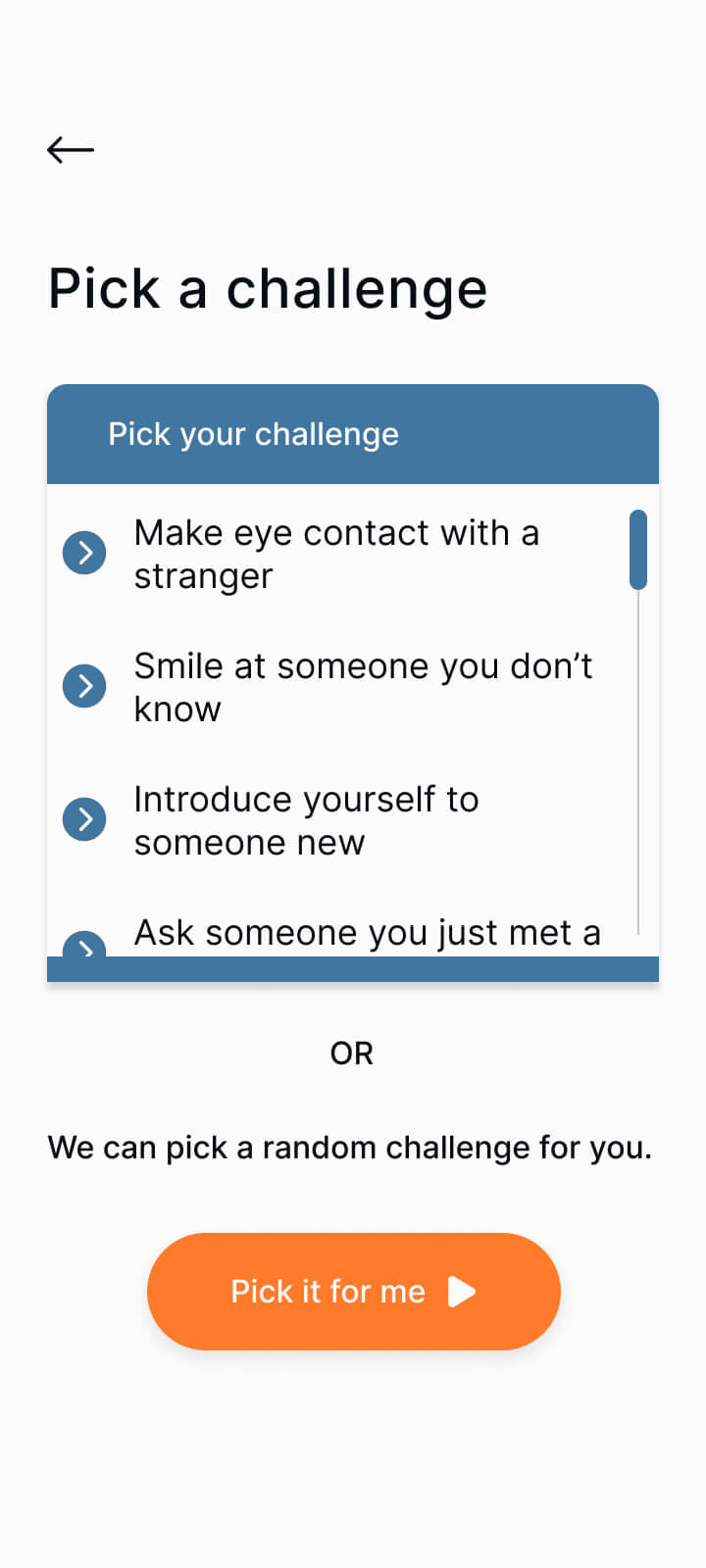
The 'Pick a challenge' category is designed for people who may not find the 'Challenge of the Day' appealing but still have the desire to take on a challenge.
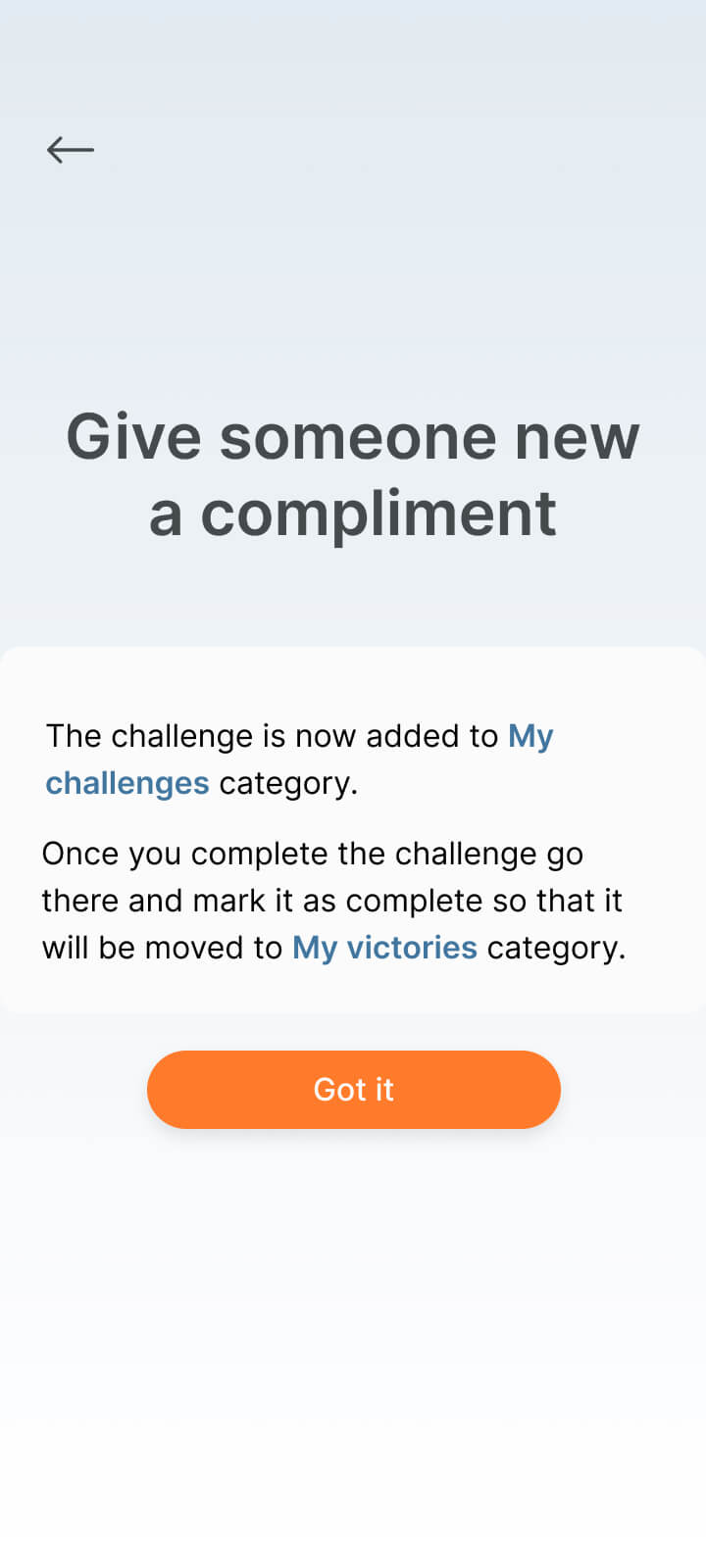
To enhance the category's entertainment value, I've incorporated a feature that allows users to generate a random challenge that they can choose to accept or decline. Upon accepting a challenge, it is saved in the 'My Challenges' category, enabling users to complete it at their own pace and mark it as done when ready.
This feature offers users a high degree of flexibility.
Initial Design
Final Designs
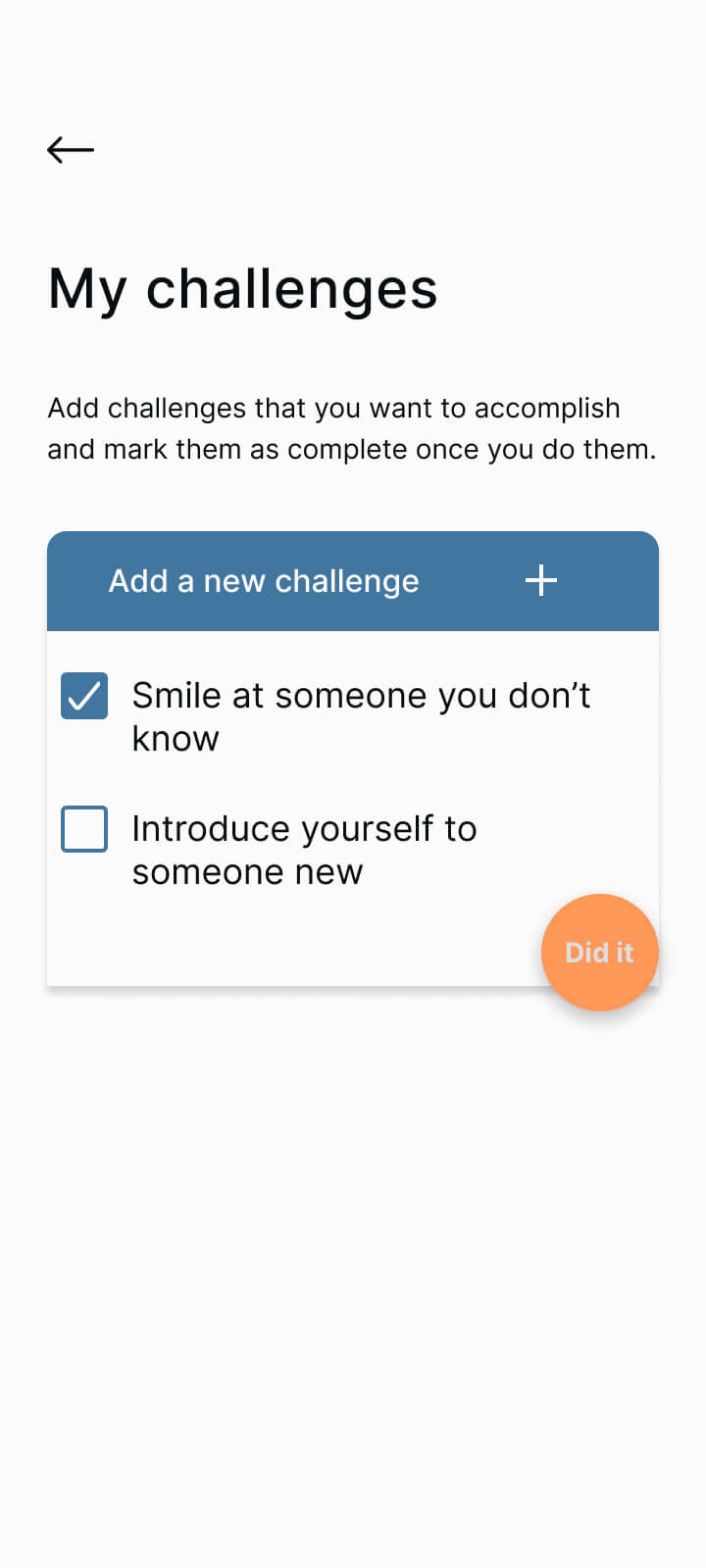
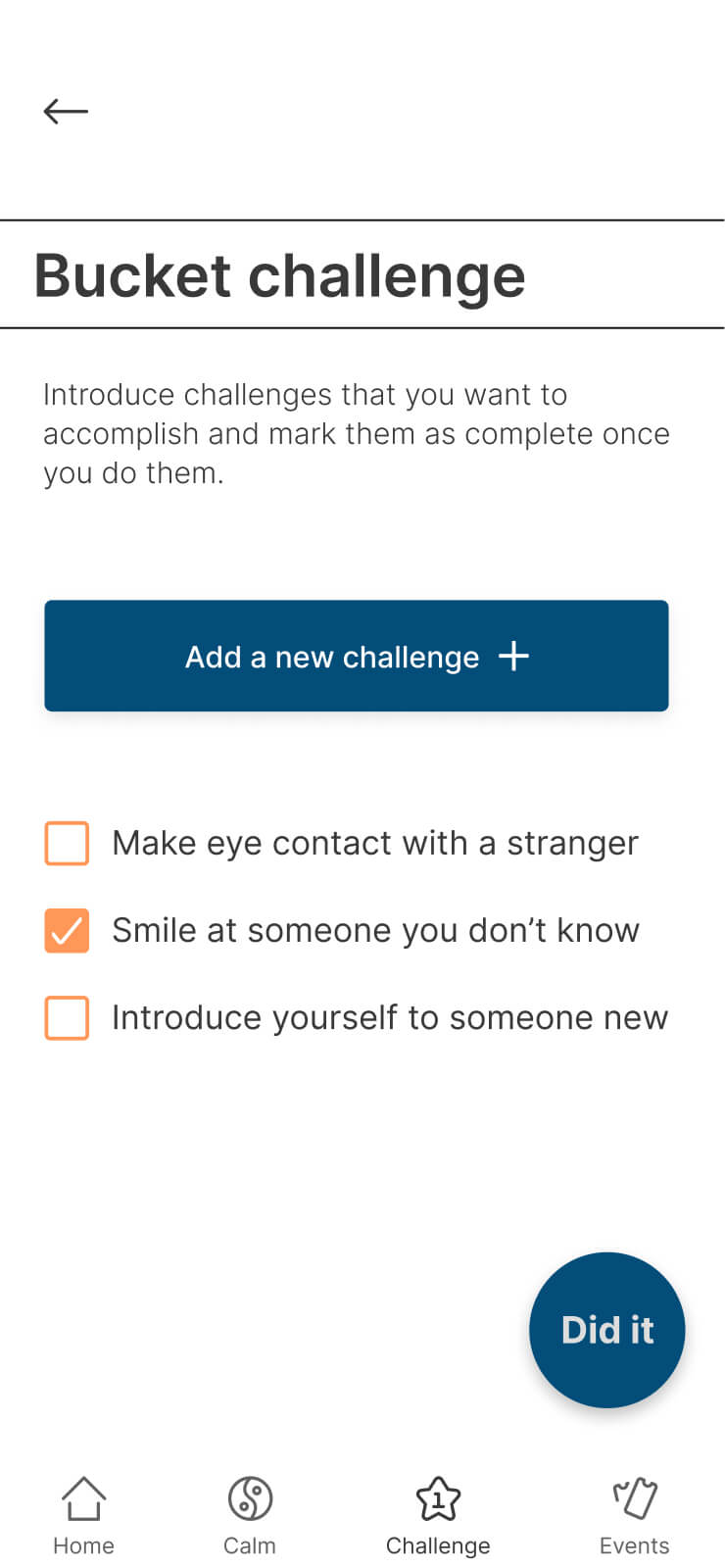
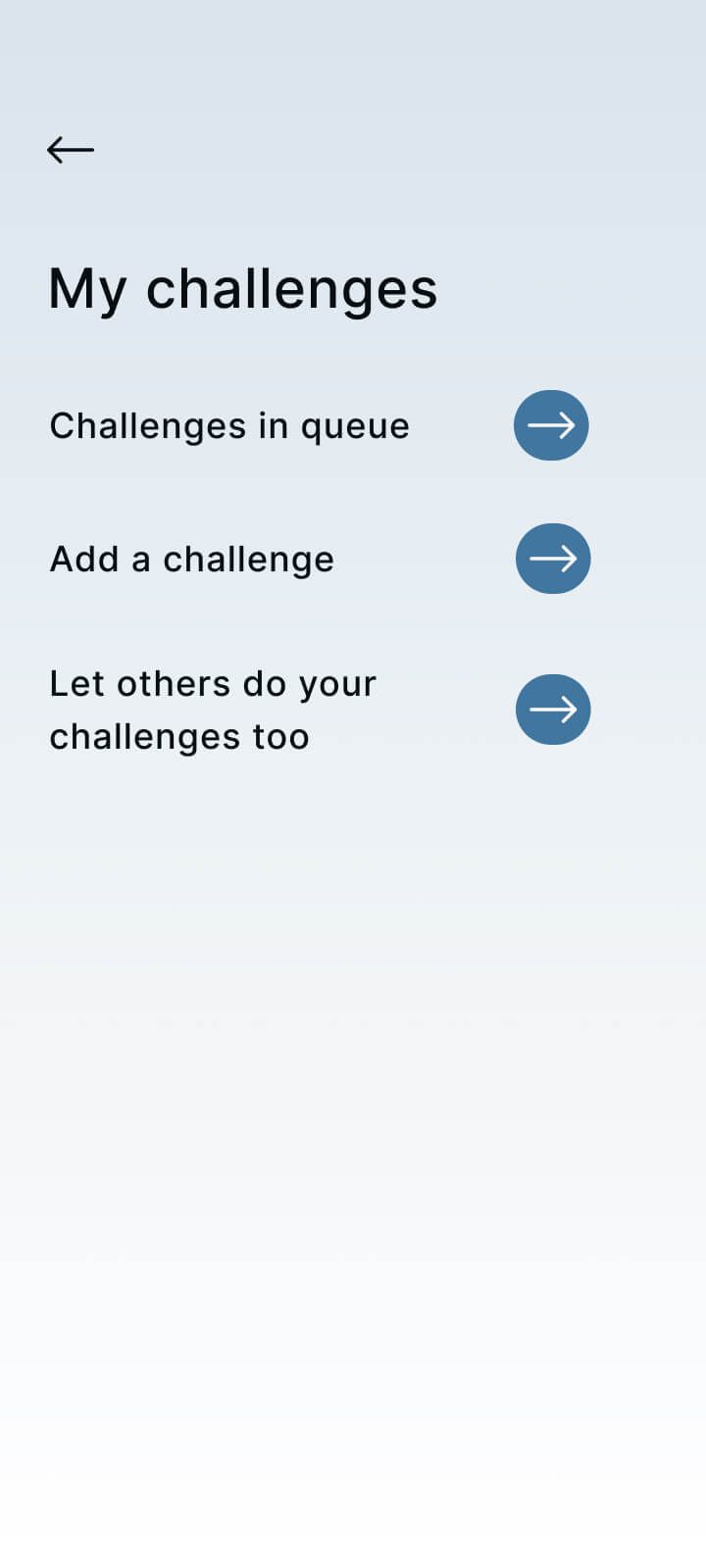
‘My challenges’ category
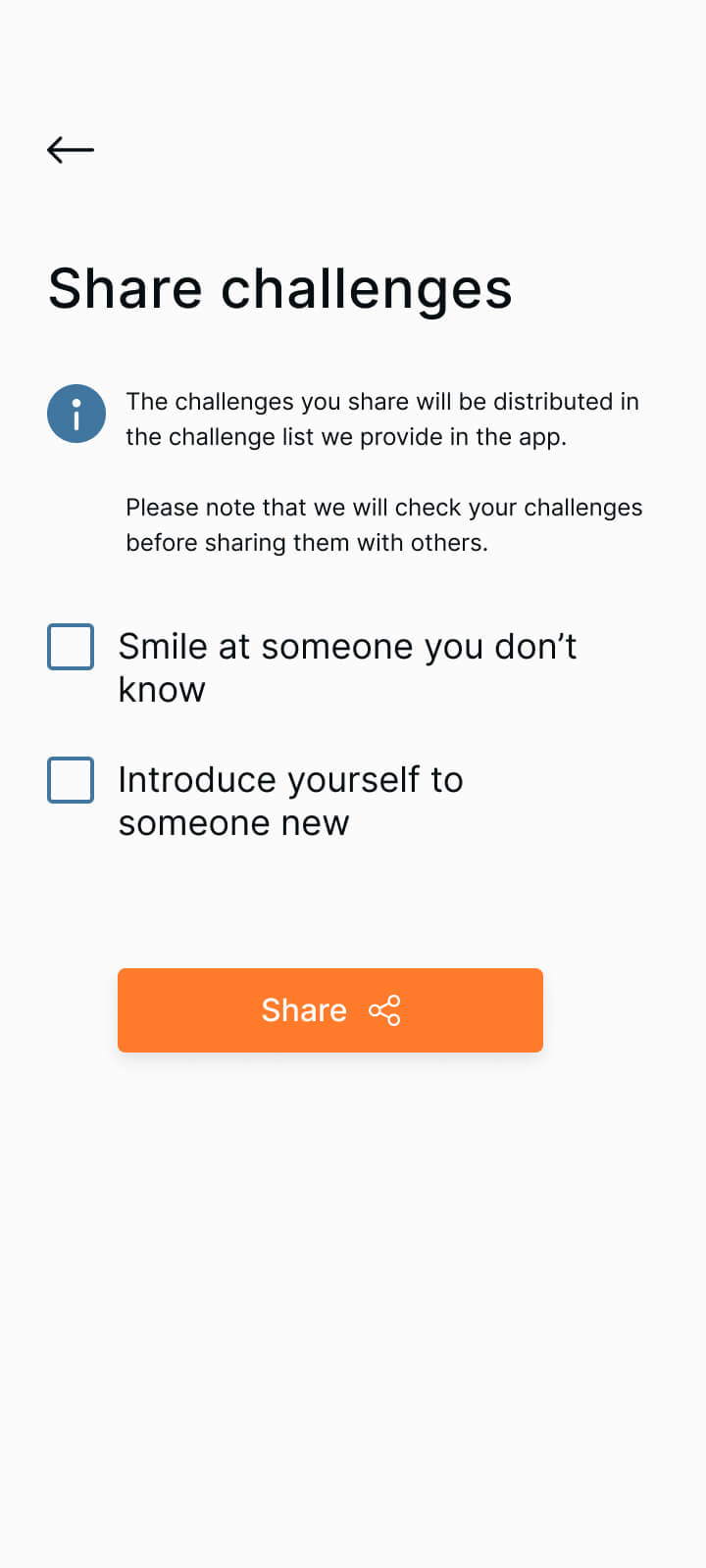
"My Challenges" category allows users to create challenges tailored to their individual goals and preferences, promoting a more personalized experience.
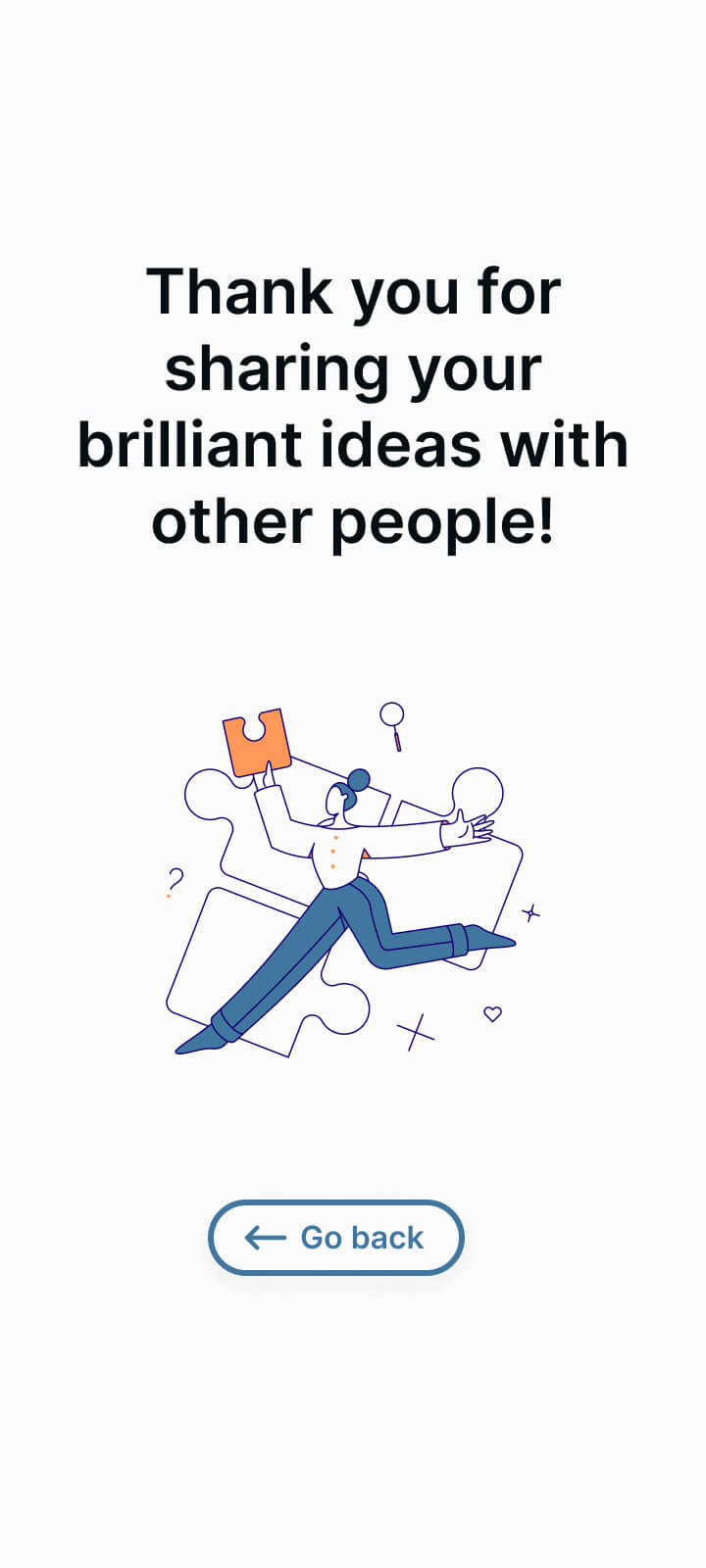
Users can also share their personal challenges, serving as inspiration for others while contributing to the expansion of available challenges within the system.
Additionally, within this category, users can keep track of the challenges they've set for themselves that are still pending.
Initial Design
Final Design
Final Designs

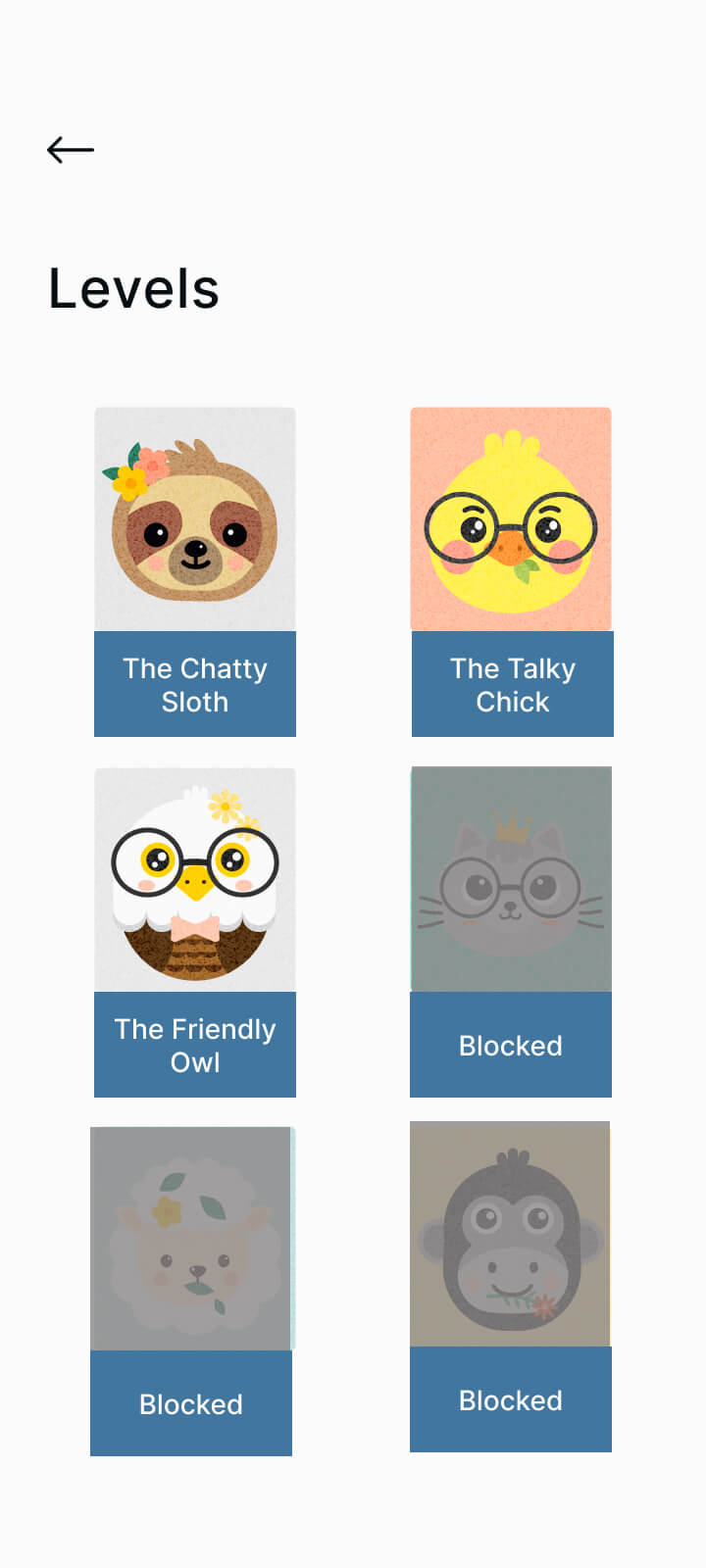
‘My victories’ category
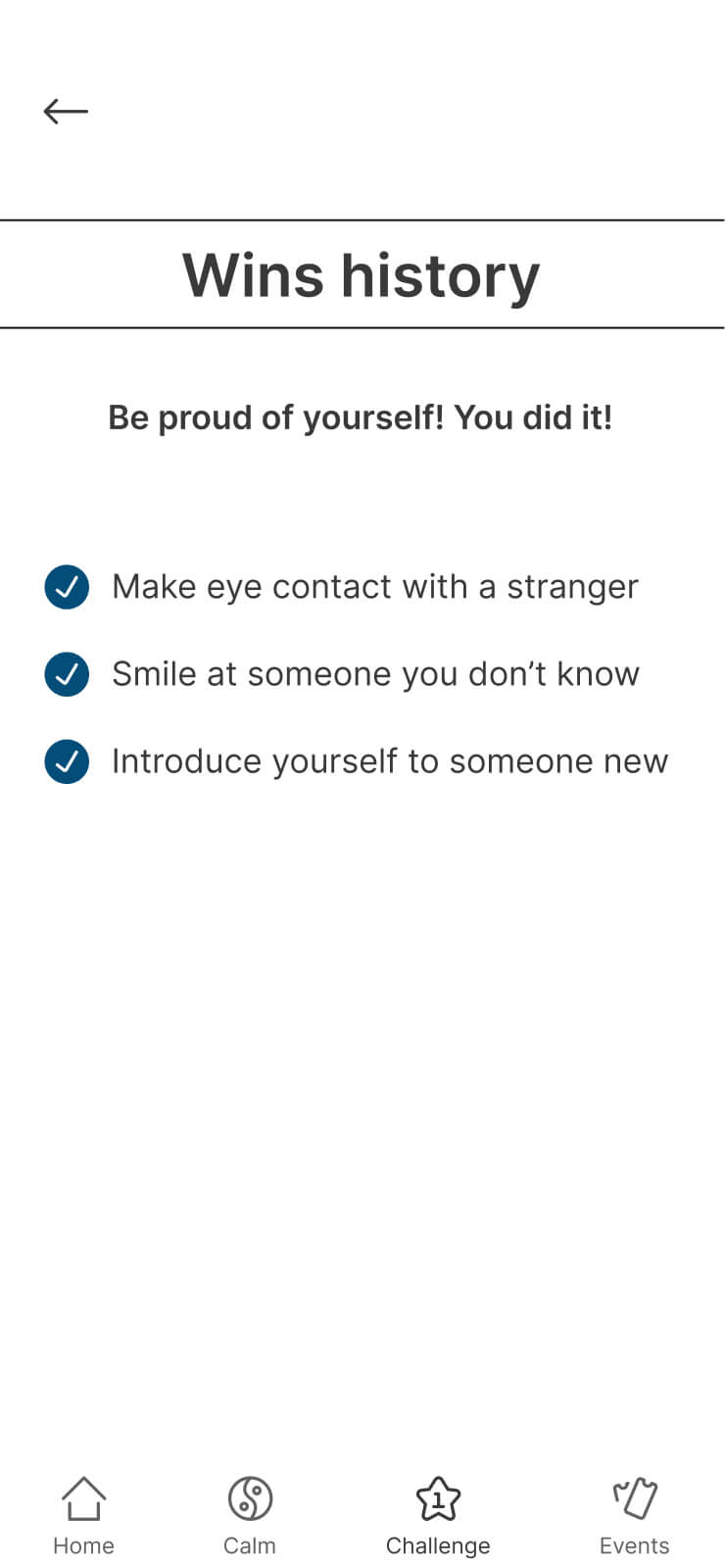
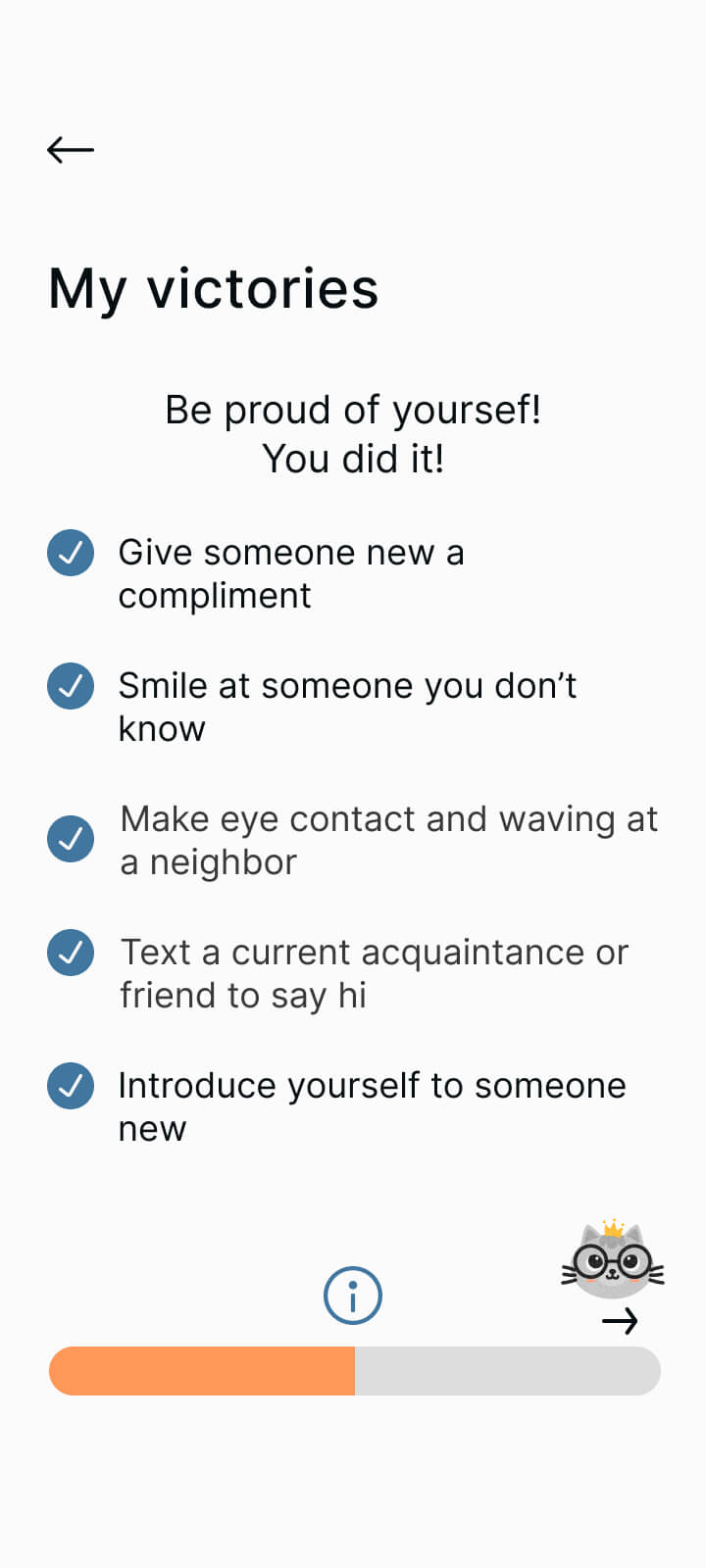
The 'My victories' category helps users keep track of their achievements and challenges completed, providing a visual record of their progress.
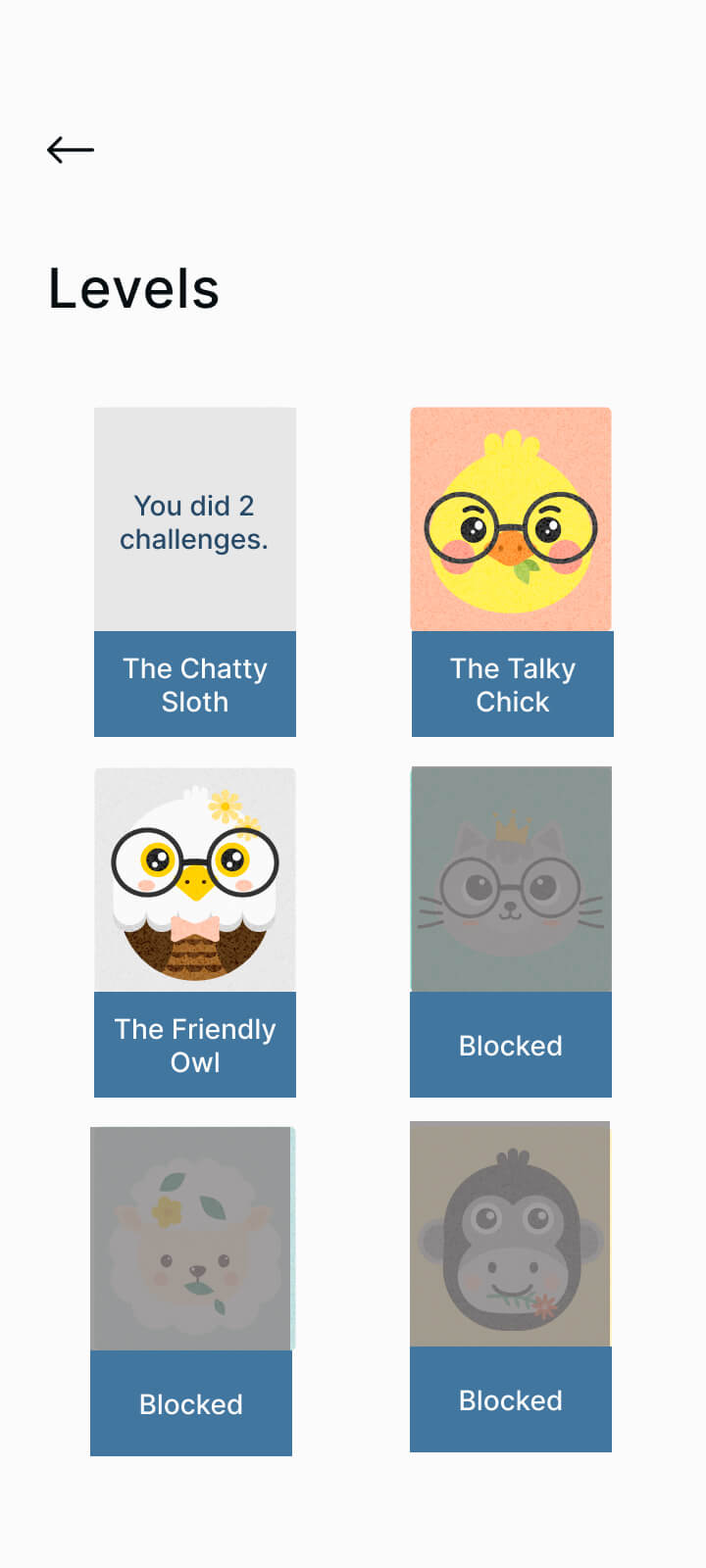
When users accomplish a specific number of challenges, they unlock new levels. This feature is intended to motivate users actively, encouraging them to take on more challenges to unlock higher levels of achievement.
Additionally, unlocking levels can provide users with a sense of accomplishment and a feeling of progression, which can boost self-esteem and confidence.
Initial Design
Final Designs
Visual Design
When designing Hush, my goal was to create an atmosphere that resonates with the app's purpose: helping people boost their self-confidence and embrace fresh opportunities.
Hush, as an app, is dedicated to reshaping the way people approach the prospect of making new friends and expanding their horizons.
The predominant use of blue palettes instills a sense of calmness and trust, fostering a positive outlook on life.
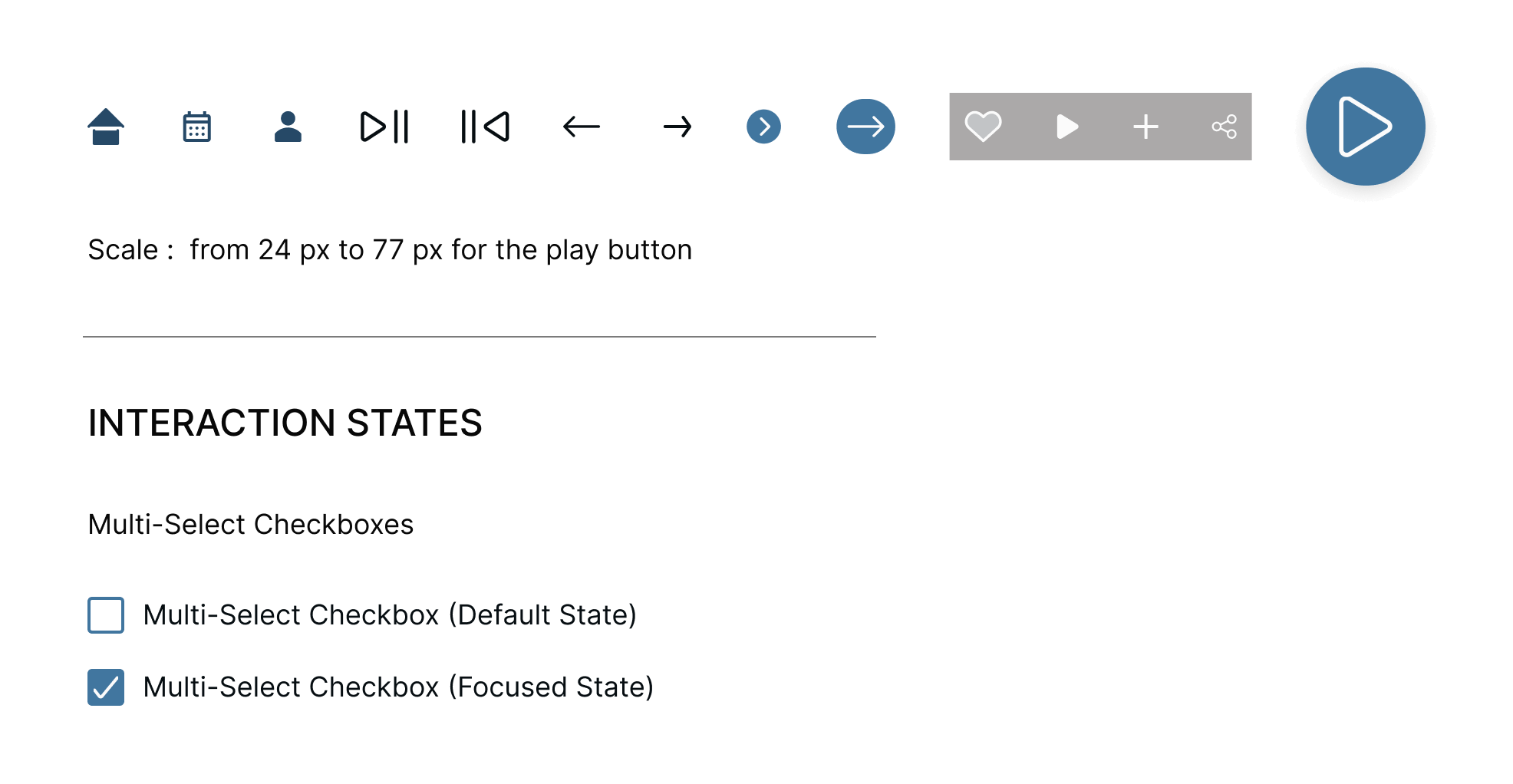
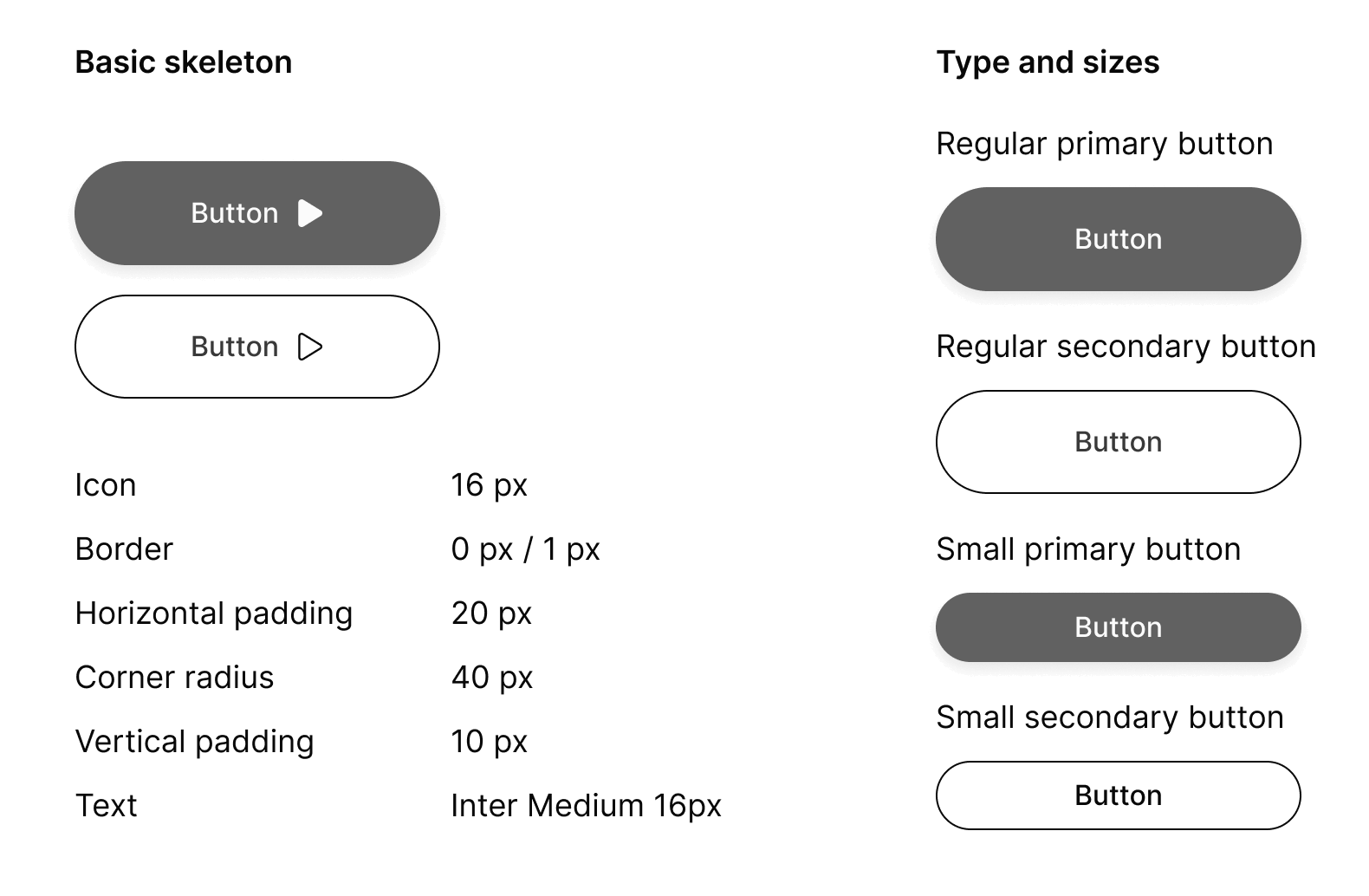
The simplicity of button states and the clarity of iconography contribute to a sense of manageability in performing tasks.
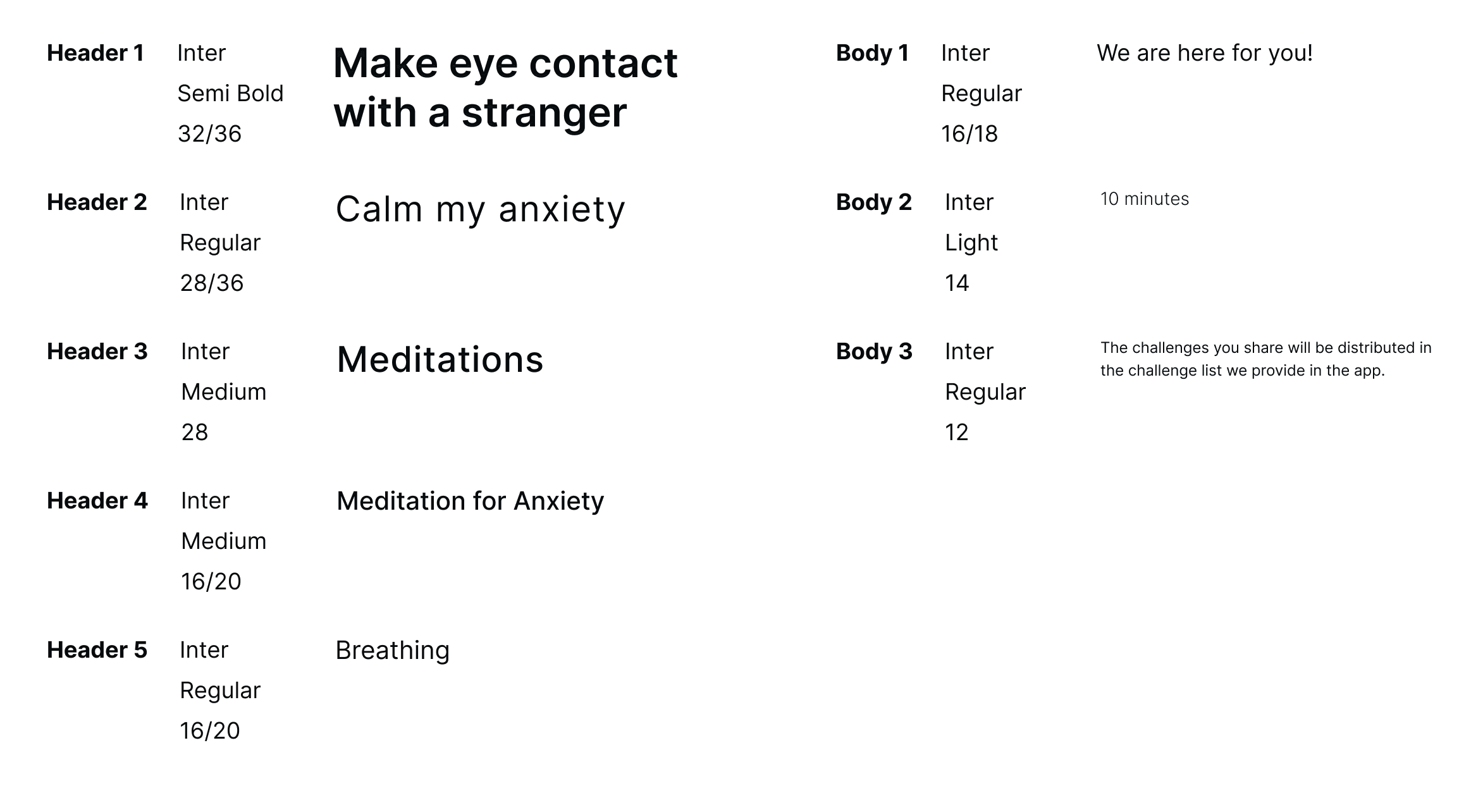
Additionally, the incorporation of a modern typeface, tailored for screens, ensures readability and an optimal user experience.
Logo

In the process of designing the logo, my aim was to design a logo that symbolized the app's purpose.
The logo, named 'Hush Your Anxiety,' encourages users to quiet their anxiety and overthinking, fostering confidence and presence.
To complement this message, I selected the 'Lobster' font for its ability to convey a sense of friendship and warmth.
Additionally, the shape above the 'h' perfectly represents the idiomatic phrase 'quiet,' reinforcing the idea of 'quiet your anxiety.
Color Palette
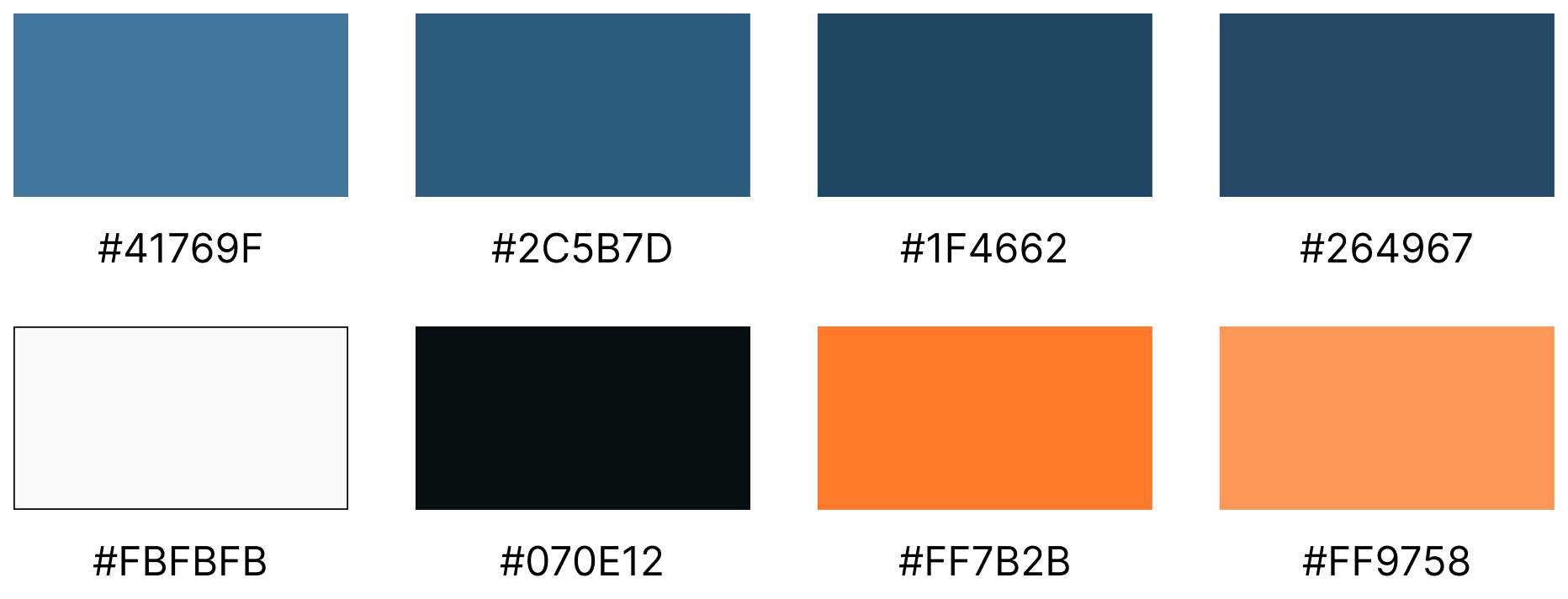
When arranging the color palette for the design, I aimed to follow the 60-30-10 rule to ensure a visually pleasing composition.
The primary colors used in the design are white (#FBFBFB) and black (#070E12), complemented by blue (#41769F) and highlighted by an energetic orange as the call-to-action hue.
Blue conveys a sense of inner security and confidence, while the orange hue is strategically chosen to ignite enthusiasm, encourage risk-taking, and foster self-assurance.
To maintain user comfort and prevent visual strain, I avoided using pure blacks and whites.
Iconography
Buttons
Typography
Inter is a variable font family designed for digital screens. It features a tall x-height to aid in readability of mixed-case and lower-case text. The Inter fonts are licensed under the Open Font License.
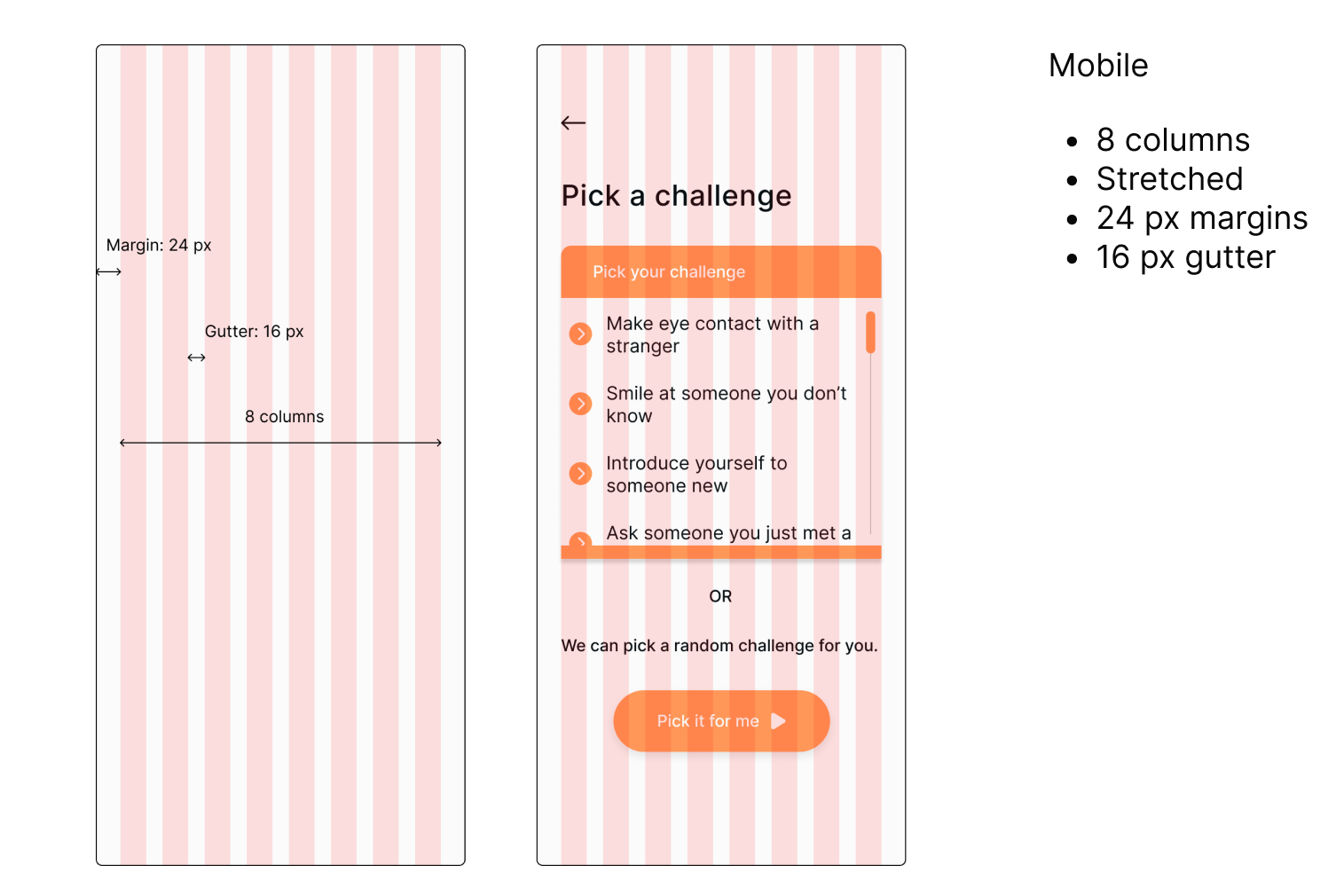
Grid
Hi-Fidelity Prototype
The prototypes allowed me to test and improve user interactions, ensuring that the final product provides a smooth and user-friendly experience.
Feel free to click the link below and interact with the app's design and functionality.
Click here to see the full hi-fi prototype in Figma.Final Thoughts
In conclusion, there are numerous areas in which this app can be enhanced. These improvements may include the implementation of advanced filtering functions for meditations and events, the incorporation of a wider variety of breathing exercises, the introduction of online therapy sessions, and the establishment of a community forum for support and story-sharing. Moreover, providing in-app guidance can significantly enhance the user experience.
Throughout this UX project, I've gained valuable insights in several key aspects. It highlighted the importance of conducting thorough research rather than making assumptions. It also taught me to maintain flexibility in problem-solving, not fixating too heavily on a single solution. Ultimately, I've come to appreciate how well-designed apps can entirely transform the user's experience.